 Aero Sync

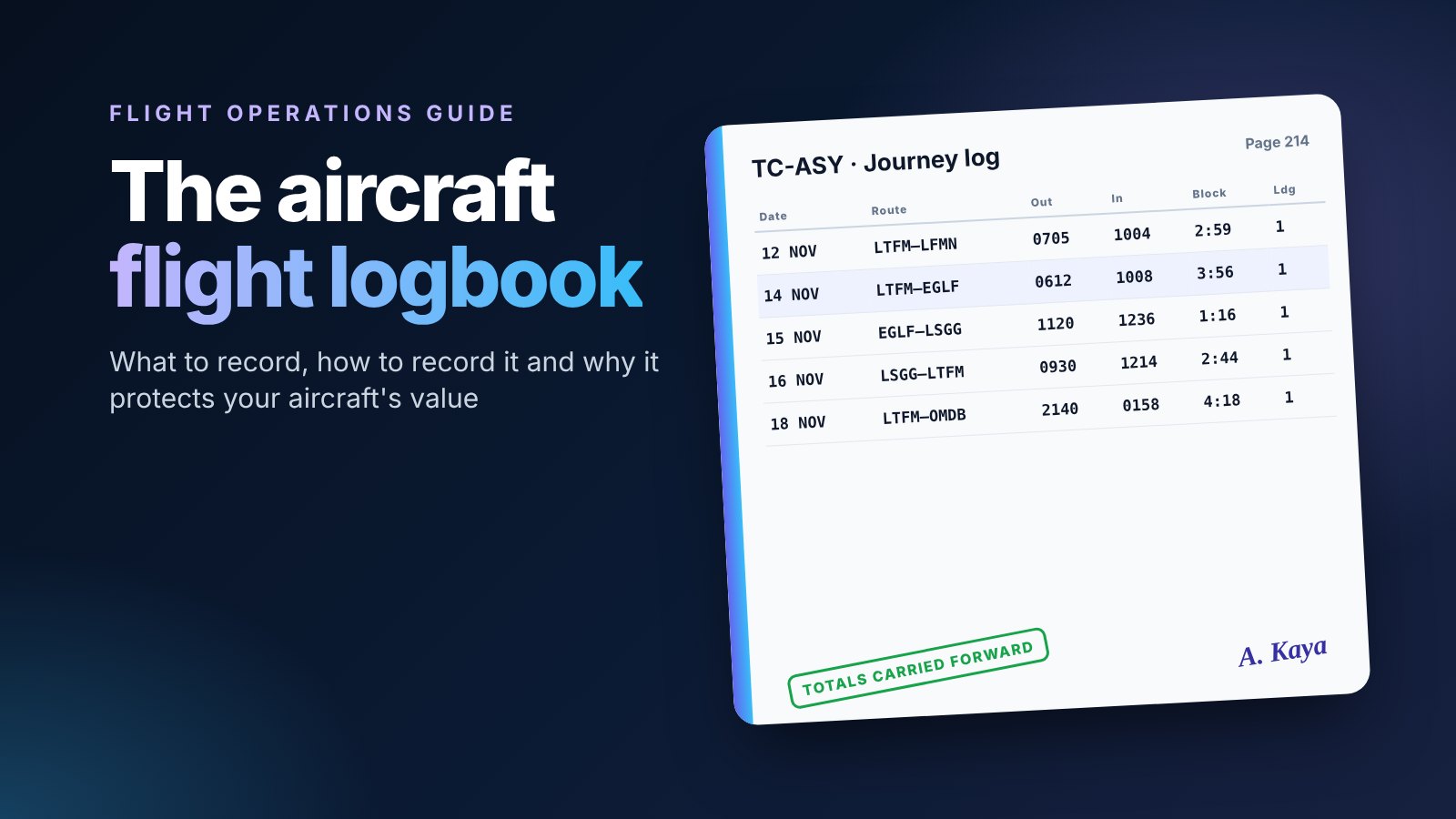
An aircraft flight logbook is the written history of every flight an aircraft makes: who flew it, where it went, when it left and arrived, and how many hours and landings it added. Those simple lines become the hours that schedule inspections, the evidence a ramp inspector asks for and the paper trail a buyer reads before signing a purchase agreement. This guide explains exactly what to record, how to turn OUT, OFF, ON and IN times into correct totals, how long to keep the records, and the mistakes that cost owners money when the aircraft is sold.
What is an aircraft flight logbook?
In everyday use, "the logbook" can mean four different records. They overlap, but each one has its own purpose, its own keeper and its own rules. Mixing them up is the most common reason entries go missing.

- Journey log or flight log. One line per flight, kept with the aircraft. It records the route, crew, times, landings and any remarks. ICAO calls it the journey log book.
- Technical log. Used mainly in commercial operations. It records defects found in flight, items deferred under the minimum equipment list and the certificate of release to service after maintenance.
- Maintenance logbooks. Separate books, or sections, for the airframe, each engine and each propeller. They carry the running total time, cycles, inspections, airworthiness directives and repairs.
- Pilot logbook. Each pilot's personal record of flight experience. It moves with the pilot from aircraft to aircraft and job to job.
The aircraft flight logbook sits at the start of this chain. If a flight is missing there, the hours never reach the maintenance records, and every total after it is wrong.
What should you record for every flight?
ICAO Annex 6, Part I, lists the minimum contents of the journey log: aircraft nationality and registration, date, crew names and duty assignments, place and time of departure and arrival, hours of flight, nature of the flight, incidents and observations, and the signature of the person in charge. A useful summary of the Annex 6 wording is published by Code7700. Most business aviation operators add a few more fields because the data is needed elsewhere.
| Field | Example | Why it matters |
|---|---|---|
| Date (UTC) | 14 Nov 2026 | Use the UTC date at OUT, so overnight flights are not counted twice. |
| Registration and type | TC-ASY · CL35 | Ties the entry to the correct airframe and engine records. |
| Crew and roles | PIC A. Kaya, SIC M. Demir | Needed for duty time, pilot logbooks and investigations. |
| From and to | LTFM → EGLF | Use ICAO four-letter codes. IATA codes are ambiguous for small airfields. |
| OUT, OFF, ON, IN | 0612 · 0624 · 1001 · 1008 | The four times every total is calculated from. |
| Block and airborne time | 3:56 · 3:37 | Block time for crew and billing; airborne time for maintenance. |
| Landings and cycles | 1 landing · 1 cycle | Cycles drive inspections and life limits on many parts. |
| Fuel | Uplift 9,400 lb, remaining 2,100 lb | Supports fuel planning, burn trends and invoices. |
| Passengers and purpose | 4 pax · owner business | Evidence for business use, tax and charter rules. |
| Defects and remarks | "No.2 pack temp fluctuating" | Starts the maintenance action and builds a defect history. |
| Signature | PIC signature or e-signature | Makes the entry a record someone is accountable for. |
Tip: write times as UTC four-digit figures (0612) and durations as hours:minutes (3:56) or decimal hours (3.9). Pick one style for durations and use it everywhere. Mixing them is the fastest way to create a total that is off by hours.
Block time, flight time and time in service
This is where most logbook confusion begins. Four moments define every flight, often called OOOI times after the order they happen in:
- OUT: the aircraft moves under its own power, usually brake release or off-blocks.
- OFF: the wheels leave the runway.
- ON: the wheels touch down.
- IN: the aircraft stops at the parking position and the brakes are set.
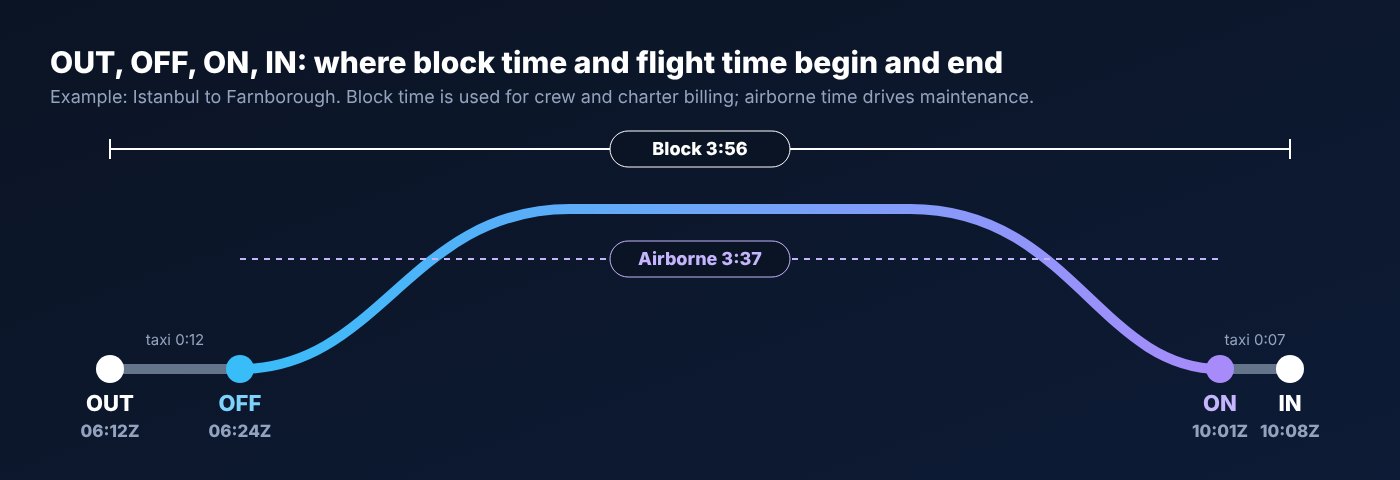
Block time runs from OUT to IN. Charter operators bill on it, crew duty and pay usually use it, and it is the figure passengers recognise as "the flight".
Airborne time runs from OFF to ON. In US rules, the maintenance clock is called time in service, defined in 14 CFR 1.1 as the time from the moment the aircraft leaves the surface of the earth until it touches it at the next point of landing. That is the number that goes into the airframe total.
Here is the trap. The same regulation defines flight time for pilots as starting when the aircraft moves under its own power for the purpose of flight and ending when it comes to rest after landing. So a pilot's "flight time" is close to block time, while the aircraft's "time in service" is airborne time. The words sound alike, but on a four-hour flight the two numbers can differ by 20 minutes or more.
Pilots log the block. The airframe logs the air. Write both down and the totals will never argue with each other.
Over a year, the gap adds up. An aircraft flying 400 legs with 15 minutes of average taxi time builds 100 hours of block time that never appear in the airframe total. If someone carries block time into the maintenance records, inspections come due early and engine reserves are overpaid. If they do the opposite with pilot records, the crew under-log their experience.
Try the logbook entry calculator
Enter the four times in UTC with the airframe totals before the flight. The calculator works out block, airborne and taxi time, carries the totals forward, shows how many hours and cycles remain before the next inspection, and writes a ready-to-copy log line. It also checks the entry for common errors, including times out of order, unusually long taxi and flights that cross midnight UTC. In the calculator, "flight time" means airborne time, the figure that goes into the airframe total.
How do you make a correct logbook entry?
A good entry takes less than two minutes if the times are captured as they happen. Leaving it until the end of the day is when numbers get guessed.
- Note OUT and OFF as they happen. Use the aircraft clock or the FMS, set to UTC. Do not round to the nearest five minutes.
- Note ON and IN on arrival. Write IN when the parking brake is set, not when the passengers leave.
- Calculate block and airborne time. If IN is earlier on the clock than OUT, the flight crossed midnight UTC: add 24 hours before subtracting.
- Convert to decimal if your records use tenths. Use the table below. Round the total, not each part.
- Count landings and cycles. A touch-and-go is a landing for the pilot and usually a cycle for the airframe. Check how your maintenance programme defines a cycle.
- Carry the totals forward. New total = previous total + airborne time. New cycles = previous cycles + cycles this flight.
- Write defects in plain words. Say what happened, when and in what phase of flight. "No.2 pack temp fluctuating in cruise FL410" is useful; "pack u/s" is not.
- Sign. The pilot in command signs on paper or applies an approved electronic signature.
Minutes to decimal hours
Each tenth of an hour is 6 minutes. Most operators round to the nearest tenth.
| Minutes | Decimal | Minutes | Decimal |
|---|---|---|---|
| 0–2 | 0.0 | 33–38 | 0.6 |
| 3–8 | 0.1 | 39–44 | 0.7 |
| 9–14 | 0.2 | 45–50 | 0.8 |
| 15–20 | 0.3 | 51–56 | 0.9 |
| 21–26 | 0.4 | 57–60 | 1.0 |
| 27–32 | 0.5 |
Worked example: block time 3:56 is 3 hours plus 56 minutes, and 56 minutes falls in the 51–56 band, so 3.9. Airborne time 3:37 gives 3.6. Adding 3.6 to an airframe total of 4,182.6 gives 4,186.2 hours.
Why the aircraft flight logbook matters
It schedules maintenance
Almost every maintenance task is due at a number of hours, a number of cycles or a calendar date, whichever comes first. Engine overhauls, landing gear life limits, hot-section inspections and many airworthiness directives all count from the totals that start in the flight log. A missing flight means a missed inspection; an extra one means paying for work earlier than needed.
The totals travel with the aircraft
In the US, 14 CFR 91.417 requires owners to keep the total time in service of the airframe, each engine, each propeller and each rotor, the current status of life-limited parts, time since last overhaul, inspection status and the status of airworthiness directives. These records must be retained and transferred with the aircraft when it is sold. Other authorities have similar rules for continuing airworthiness records.
It protects resale value
A pre-purchase inspection always starts with the records. Gaps in the logbooks, totals that do not add up or missing signatures lead to price reductions, extra inspections or buyers walking away. Complete, consistent records can be worth more to the sale than a fresh coat of paint. If you are deciding how to acquire an aircraft, our guide to leasing versus buying a private jet explains why the records matter at the end of a lease as well.
It answers the ramp check
Inspectors on a ramp check can ask for the journey log or technical log to see that defects were recorded and dealt with and that the aircraft was released correctly. A clean, current log answers most questions in minutes.
It supports costs, tax and business use
Flight purpose, passengers and hours are the evidence for business-use claims, cost allocation between owners and charter revenue. They also feed hourly cost figures. Our breakdown of the cost of owning a private jet shows how much of the budget is calculated per flight hour.
It shows trends before they become failures
A defect that appears once is a snag. The same defect on five flights in a month is a trend. Reading the remarks column across many entries is one of the simplest safety tools an operator has.
How long do you have to keep aircraft logbooks?
Retention depends on the record and the authority. The table shows the common baseline; your State and operator approval may require more.
| Record | Typical retention | Source |
|---|---|---|
| Records of maintenance, preventive maintenance and alterations | Until the work is repeated or superseded, or one year after the work | 14 CFR 91.417(b)(1) |
| Total time, life-limited parts, overhaul, inspection and AD status | Kept for the life of the aircraft and transferred on sale | 14 CFR 91.417(b)(2) |
| Journey log | Kept current; retained for a period set by the State | ICAO Annex 6, Part I |
| Pilot logbook | No fixed limit; most pilots keep it for life | 14 CFR 61.51 |
In practice, keep everything. Storage is cheap, and a missing page from ten years ago can still cost money at the next sale.
Paper or electronic logbook?
Paper logbooks are simple and accepted everywhere, but they can be lost, damaged or hard to read, and every total has to be added by hand. Electronic logbooks calculate totals automatically, catch errors at the time of entry, can be searched in seconds and back themselves up.
Electronic records are widely accepted when the system meets the authority's requirements. The FAA's Advisory Circular 120-78A describes acceptable electronic signatures, recordkeeping and manuals, including how to make sure a signature is unique, linked to the record and cannot be changed afterwards. Other authorities publish similar guidance. Before switching, check what your authority and maintenance organisation accept, and keep exports in a format you can still open in ten years.
Good practice for electronic logs: unique log-in for each person, an audit trail of every change, regular exports to a format such as CSV or PDF, and a clear way to correct an entry without deleting the original.
Common logbook mistakes
Watch for these: logging block time into the airframe total; local times mixed with UTC; overnight flights entered with a negative duration; rounding each leg instead of the total; landings and cycles not recorded; defects described as "u/s" with no detail; corrections made by erasing instead of a single line and initials; totals carried forward from the wrong page.
Most of these mistakes come from the same cause: the entry was written from memory hours later. Capturing the four times as they happen, in UTC, prevents almost all of them.
Key takeaways
- An aircraft flight logbook records the route, crew, OOOI times, landings, fuel, purpose and defects for every flight.
- Block time (OUT to IN) is for crew and billing. Airborne time (OFF to ON) is what goes into the airframe total.
- Hours and cycles from the flight log drive inspections, life limits and AD compliance.
- Total time and status records stay with the aircraft and transfer when it is sold.
- Record times in UTC as they happen and sign every entry.
Keep your flight log in Aero Sync
The Aero Sync Flight Logbook keeps every leg in one searchable place: route, OUT and IN times, block and airborne time, landings, night and IFR time, PIC and SIC, passengers, fuel and remarks. Running totals update automatically, completed flights from Flight Operations can be added in one click, and the whole log can be exported for your maintenance team, accountant or buyer.
Frequently asked questions
What is an aircraft flight logbook?
It is the record of every flight an aircraft makes, including the date, registration, crew, departure and arrival airports, OUT, OFF, ON and IN times, landings, fuel, purpose and any defects, signed by the pilot in command.
What must be recorded in an aircraft journey log?
ICAO Annex 6 lists the registration, date, crew names and duties, places and times of departure and arrival, hours of flight, nature of the flight, incidents and observations, and the signature of the person in charge.
What is the difference between block time and flight time?
Block time runs from OUT (first movement) to IN (parked). Airborne time runs from OFF (take-off) to ON (touchdown). The difference is taxi time. A pilot's logged flight time is close to block time, while the airframe total uses airborne time.
Is aircraft total time based on block time or airborne time?
Under US rules the airframe total uses time in service, which runs from take-off to landing. That is airborne time, not block time.
Who is responsible for the aircraft logbooks?
The pilot in command is responsible for each flight entry. The owner or operator is responsible for keeping the maintenance records, often through a maintenance or continuing airworthiness organisation.
How long must aircraft maintenance records be kept?
In the US, work records are kept until the work is repeated or superseded, or for one year. Total time, life-limited parts, inspection and AD status are kept for the life of the aircraft and transferred when it is sold.
Are electronic aircraft logbooks legal?
Yes, in many countries, when the system meets the authority's requirements. FAA AC 120-78A explains acceptable electronic signatures and recordkeeping. Check with your own authority before going paperless.
How do you convert minutes to decimal hours?
Divide the minutes by 60, or use 6 minutes per tenth. For example, 3 hours 56 minutes is 3.9 hours, and 3 hours 37 minutes is 3.6 hours.
How do you log a flight that crosses midnight?
Use the UTC date at OUT for the entry. When calculating durations, add 24 hours to the later time if it is smaller than the earlier one. For example, OUT 2340 and IN 0652 gives 7:12 of block time.
What is a cycle in an aircraft logbook?
For most jets, one cycle is one take-off and landing, or one pressurisation cycle. Engines may also count start cycles. Your maintenance programme defines exactly what counts.
How do you correct a mistake in a paper logbook?
Draw a single line through the wrong entry so it stays readable, write the correct value next to it and add your initials and the date. Never erase or use correction fluid.
What happens if aircraft logbooks are lost?
The records must be reconstructed from other sources, such as invoices, work orders and flight data, and the aircraft may need extra inspections. Missing logbooks usually reduce an aircraft's market value significantly.