 Aero Sync

Few decisions move as much money as the lease vs buy private jet question. Choose well and you protect millions in capital. Choose badly and you can lose more in value, interest or lease payments than you ever spend on fuel. This guide walks owners, CFOs and family offices through every option, with a clear 10-year cost model you can adapt to your own numbers.
Before you start: this article explains how the options work and how to compare them. It is not tax, legal or investment advice. Rules differ by country and change often, so run your final numbers with an aviation tax adviser and a lawyer.
What are your options for getting a private jet?
There are four main ways to put a business jet on your ramp. Each one shifts cost, risk and control in a different direction.
1. Buy with cash
You pay the full price and own the aircraft outright. There are no monthly payments to a lender or lessor, and you control every decision about the jet.
The catch is capital. Money tied up in an aircraft cannot be invested elsewhere. You also carry the full risk of the jet losing value, which is usually the single biggest cost of ownership.
2. Buy with a loan
You put down part of the price and borrow the rest. Lenders often ask for a down payment of around 15–25% for business jets. Loans commonly run five to ten years, sometimes with a larger final "balloon" payment.
You still own the aircraft and keep the tax depreciation, where it applies. You and the lender share the value risk until the loan is repaid. In return, you pay interest on top of the price.
3. Operating lease (dry lease)
A leasing company buys the jet and rents it to you for a fixed term, usually five to ten years. You pay a monthly rent and run the aircraft as if it were yours. At the end, you hand it back, extend the lease or buy it.
The lessor owns the jet, so the lessor carries the residual value risk. That is the main attraction: your cost is known in advance. According to AvBuyer, lessors also keep the tax depreciation, and many require the engines to be enrolled in an hourly maintenance programme.
Private lessees almost always take a dry lease: the aircraft only, with you providing crew and operational control. A wet lease, which includes crew, is usually a commercial charter arrangement that needs an air operator certificate.
4. Finance lease
A finance lease looks like a lease but works more like a loan. The payments cover most of the aircraft's value, and you usually own it at the end or buy it for a small amount. For accounting and tax, it is often treated as a purchase. Ask your accountant how it would sit on your balance sheet.
What about fractional ownership and jet cards?
If you fly a limited number of hours a year, owning or leasing a whole jet may not be the right comparison at all. Fractional shares, jet cards and on-demand charter give you access without a whole aircraft to manage. As a rough guide, compare these first if you fly fewer than about 150–200 hours a year. Our Charter vs Card vs Own tool compares them side by side.
Lease vs buy private jet: the 10-year numbers
To make the trade-offs concrete, here is a simple model for a $20 million jet over ten years. It compares only the cost of having the aircraft. Crew, fuel, maintenance, hangar and insurance are roughly the same whichever way you hold it, so they are left out.
| Assumption | Value used |
|---|---|
| Aircraft price | $20,000,000 |
| Period compared | 10 years |
| Value decline | 6% a year (also tested at 4% and 8%) |
| Loan | 20% down, $16M over 10 years at 6.5% |
| Operating lease | 0.75% of the price a month ($150,000) |
| Discount rate | 5% a year (what your cash could earn elsewhere) |
With a 6% yearly decline, the jet is worth about $10.8 million after ten years. Here is what each option costs.
| Option | Paid over 10 years | Value at the end | Net cost | Cost in today's money |
|---|---|---|---|---|
| Buy with cash | $20.0M | $10.8M | $9.2M | $13.4M |
| Buy with a loan | $25.8M | $10.8M | $15.0M | $14.6M |
| Operating lease | $18.0M | None | $18.0M | $14.2M |
The "net cost" column looks like a clear win for cash. That view is misleading, because $20 million spent today is worth far more than $10.8 million received in ten years. The last column fixes this. It converts every payment into today's money using a 5% discount rate, which is the fair way to compare.
The loan payment in this model is about $181,700 a month, with roughly $5.8 million of interest over ten years. It costs more than cash here because the loan rate (6.5%) is higher than the 5% the cash could otherwise earn. If you can borrow cheaper than your money earns, the loan becomes the cheapest way to buy.
Why does the jet's value decide the answer?
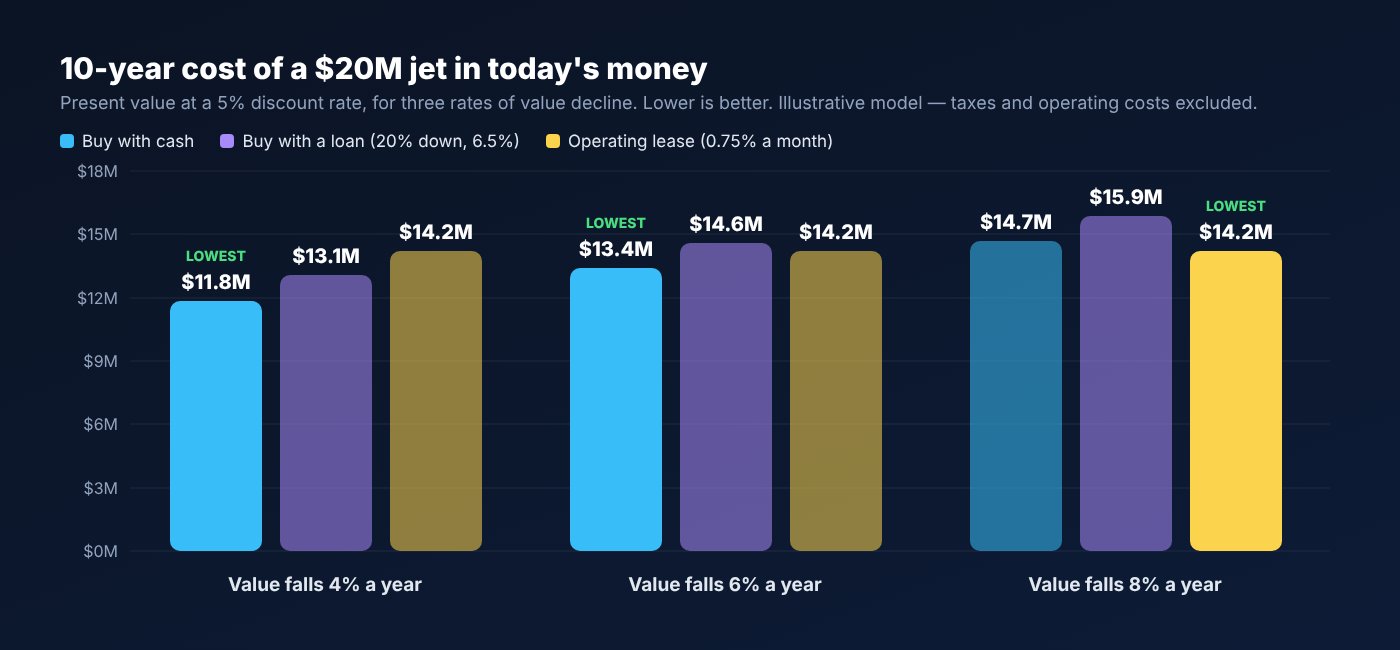
Look at the chart again. The lease cost stays at $14.2 million in every scenario, because the lessor takes the value risk. The cost of owning moves with the market.
- If the jet loses 4% a year, buying with cash costs $11.8M and clearly beats the lease.
- At 6% a year, cash still wins, but only by about $0.8M.
- At 8% a year, the lease becomes the cheapest option.
So how fast do jets lose value? It depends heavily on the model, its age and the market. Analysis by senior analyst Daniel Hall found new business jets lost an average of about 9.4% a year over their first five years, keeping roughly 61% of their value. Older aircraft usually lose value more slowly in percentage terms. Popular models with strong support hold value best. Out-of-production types and aircraft with costly upcoming inspections lose value fastest.
When you lease, you are effectively paying the lessor to take this risk. Part of the monthly rent is the lessor's estimate of how much value the jet will lose.
Tip: before you sign, ask an appraiser for a residual value forecast for your exact model. Then run the model with an optimistic and a pessimistic value. If buying only wins in the optimistic case, the lease may be the safer choice.
How long will you keep the aircraft?
Holding period is the second big driver. Buying and selling a jet carries one-off costs, and the steepest value loss happens in the early years. A lease spreads its cost evenly.
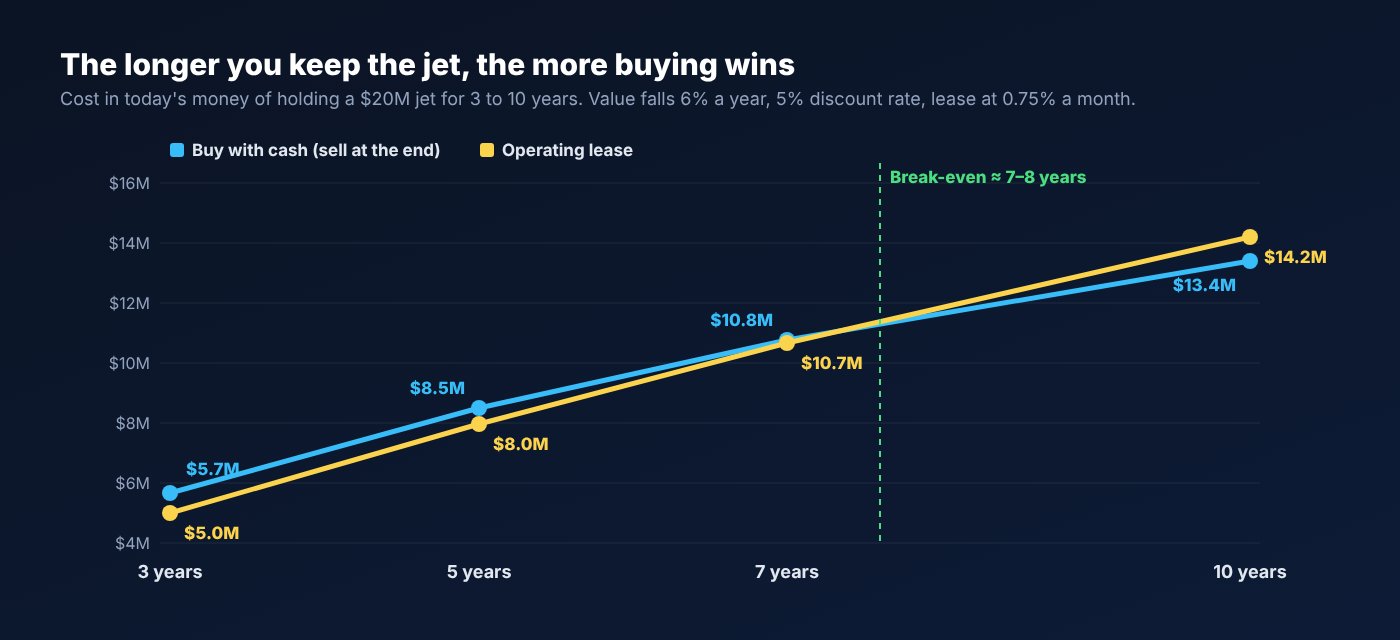
In this model, leasing is cheaper if you keep the jet for three, five or seven years. Buying wins at around eight years and beyond. Real transaction costs, such as broker fees, pre-buy inspections and registration, make short ownership even more expensive. So if you expect to change aircraft within a few years, look hard at leasing.
How do taxes change the lease vs buy decision?
Taxes can flip the result completely, which is why the model above leaves them out. The main points differ by country, but these are the questions to ask.
Depreciation for owners
In the United States, the 2025 tax law restored 100% bonus depreciation and made it permanent. As Husch Blackwell explains, it applies to qualifying new or pre-owned aircraft placed in service from 20 January 2025. That can let a business owner deduct the full price in the first year.
There are strict conditions. The aircraft generally must be used mainly for qualified business purposes, and personal use is limited and taxed. When you sell, depreciation you have claimed can be "recaptured" as taxable income. The NBAA publishes detailed guidance on these rules.
Deductions for lessees
When you lease, the lessor claims the depreciation, not you. In return, your lease payments may be deductible when the aircraft is used for business. If you cannot use large depreciation deductions, for example because of losses or your company structure, leasing often looks better after tax.
Sales, use and VAT
Some US states charge sales or use tax on lease payments instead of the full purchase price, as Business Jet Traveler notes. In Europe, VAT and customs import rules can add a large cost if the structure is wrong. Many owners use specialist import and leasing structures, which need expert advice.
Important: tax savings are only real if the aircraft is used the way the rules require. Keep detailed flight logs showing the business purpose of every trip. Poor records are the most common reason deductions are refused.
When does buying a private jet make sense?
- You plan to keep the aircraft for eight years or more.
- You chose a model with strong, stable resale values.
- You can use depreciation deductions and meet the business-use rules.
- You want full control over modifications, interior, registration and charter.
- You have spare capital, or can borrow at a rate below what your money earns.
- You fly many hours a year and want the aircraft available at all times.
When does leasing a private jet make sense?
- You expect to change aircraft or your needs within five to seven years.
- You want a fixed, predictable cost and no exposure to falling values.
- Your capital earns more in your business than it would save in an aircraft.
- You cannot use depreciation deductions efficiently.
- You need a jet quickly, for example while waiting for a new delivery. Short leases of 18 to 24 months exist, at higher rates.
- You want the aircraft off your balance sheet, where accounting rules allow it.
What should you check in a private jet lease?
The monthly rate is only part of the deal. These terms often decide whether a lease is good value.
| Term | What to look for |
|---|---|
| Lease rate factor | Monthly rent as a % of value. Business jet rates are often well below the old 1% rule of thumb. |
| Term and early buy-out | Fixed buy-out options, for example in years four to six, give you a way out. |
| Return conditions | The condition the jet must be in when you hand it back. Strict terms can cost millions. |
| Usage limits | Extra charges if you fly more hours or cycles than agreed. |
| Engine programme | Many lessors require an hourly engine maintenance programme. |
| Maintenance reserves | Monthly amounts set aside for major inspections, and whether you get them back. |
| Insurance and registration | Minimum cover, named insureds and where the aircraft is registered. |
| Purchase option | Whether you can buy the jet at the end, and at what price. |
Lease vs buy private jet: side-by-side summary
| Buy with cash | Buy with a loan | Operating lease | |
|---|---|---|---|
| Upfront cash | Full price | Down payment | Deposit only |
| Monthly cost | None | Loan payment | Lease rent |
| Value risk | All yours | Shared with the lender | Lessor's |
| Tax depreciation | Yours | Yours | Lessor's |
| Flexibility to change jets | Must sell | Must sell and repay | Hand back at term end |
| Control | Full | Full, within loan terms | Within lease terms |
| Best for | Long holds, spare capital | Long holds, cheap borrowing | Short holds, fixed budgets |
Buying wins when values hold and you keep the jet for years. Leasing wins when values fall, plans change or capital works harder elsewhere.
Key takeaways
- Compare options in today's money, not total payments.
- The jet's future value is the biggest single driver of the answer.
- Leasing usually wins for holds under about seven years. Buying usually wins beyond that.
- A loan beats cash when you can borrow below what your money earns.
- Taxes can flip the result, so model them with an adviser.
- Read the return conditions before you sign any lease.
How to run your own lease vs buy numbers
Every aircraft, budget and tax position is different, so use this model as a starting point. Aero Sync includes the tools to test your own case in minutes.
- The Lease vs Buy calculator compares cash, loan and lease side by side in today's money.
- The Aircraft Financing tool builds the full loan schedule, including balloon payments.
- The Depreciation Calculator tests optimistic and pessimistic value scenarios.
Each tool exports a board-ready PDF and Excel file that you can share with your CFO, lender or tax adviser.
Run your lease vs buy numbers free
Frequently asked questions
Is it cheaper to lease or buy a private jet?
It depends on how long you keep the aircraft and how fast it loses value. In a typical model, leasing is cheaper for holds under about seven years, and buying is cheaper beyond that. Taxes and borrowing costs can change the result.
How much does it cost to lease a private jet?
Operating lease rents are usually quoted as a monthly percentage of the aircraft's value. For business jets they are often well below 1% a month. For a $20 million jet, 0.75% a month means $150,000, before crew, fuel and maintenance.
Who pays for maintenance on a leased private jet?
Under a dry operating lease, the lessee normally pays for maintenance, crew, fuel and insurance. Many lessors also require an hourly engine maintenance programme and set strict return conditions.
Can you claim depreciation on a leased jet?
Usually not. The lessor owns the aircraft and claims the depreciation. The lessee may be able to deduct lease payments when the aircraft is used for business, depending on local tax rules.