 Aero Sync

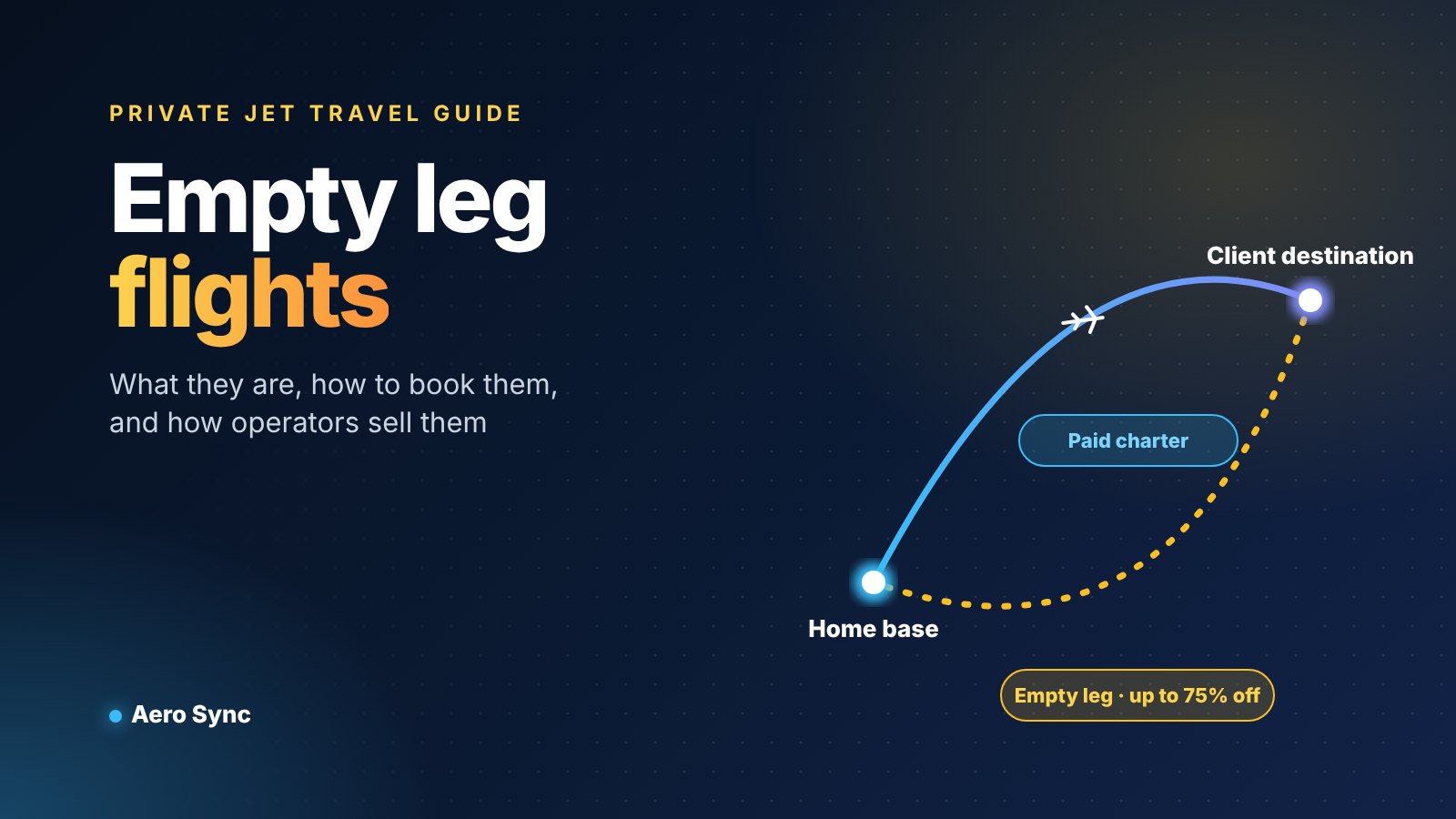
Empty leg flights are the closest thing private aviation has to a last-minute deal. A jet has to fly somewhere without passengers, so the operator sells the trip at a large discount. For travellers, that can mean a private jet for a fraction of the normal price. For operators and brokers, it turns a costly empty flight into revenue and new clients. This guide explains how empty leg flights work from both sides.
What is an empty leg flight?
An empty leg is a private jet flight that would otherwise fly with no passengers on board. It happens because charter clients book where they need to go, not where the jet needs to be afterwards. You may also hear it called a dead leg, deadhead, ferry flight, repositioning flight or one-way special.
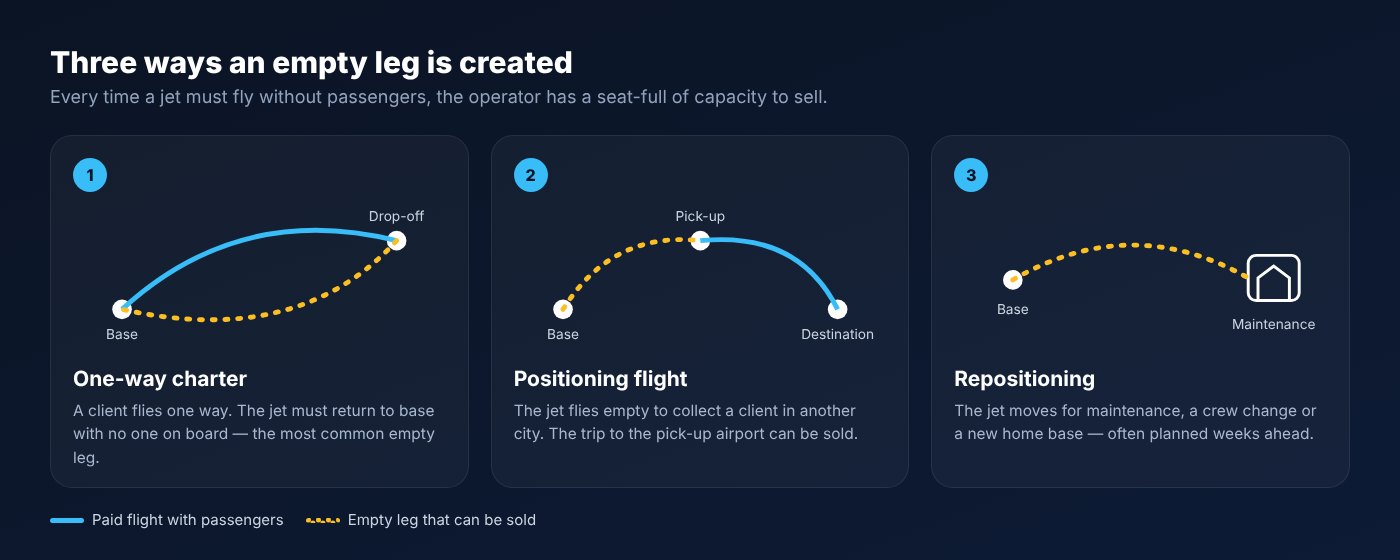
Because the flight is going ahead anyway, almost any price the operator receives is better than nothing. That is why empty legs are offered far below the normal charter rate.
Why are there so many empty leg flights?
Private jets do not fly fixed schedules like airlines. Every trip starts and ends where the client wants, so the aircraft often finishes in the wrong place. An industry estimate quoted by Business Airport International puts empty return legs at about 40% of private jet flights.
That is a lot of unused capacity. It is also why empty legs are concentrated on busy charter routes, such as New York to Florida in winter or London to the Mediterranean in summer. Popular one-way trips create popular empty returns.
How much can you save on empty leg flights?
Savings are often large. According to The Points Guy, empty legs are typically priced about 50–75% below a normal charter. Its example: a midsize jet from New York to South Florida can cost upwards of $20,000 one way, while empty legs on the route often sell for $9,000–$12,000.
| Normal one-way charter | Empty leg | |
|---|---|---|
| Price | Full charter rate | Often 50–75% lower |
| Route and date | You choose | Set by the operator |
| Departure time | You choose | Fixed or a small window |
| Guaranteed? | Yes, as contracted | Can be cancelled if the main trip changes |
| Catering and extras | Fully tailored | Often basic or extra cost |
| Return trip | Can be booked together | Usually one way only |
The whole aircraft is yours, so the saving per person grows with the number of passengers. Four friends sharing a discounted light jet can pay less each than a premium airline seat on some routes.
What is the catch with empty leg flights?
Empty legs are cheap because the operator's main client comes first. That brings a few trade-offs every traveller should understand before booking.
- The schedule is fixed. The jet must be in place for its next paid trip, so the time and route rarely change.
- It can be cancelled. If the main charter moves or is cancelled, your empty leg may disappear too, sometimes at short notice.
- It is usually one way. You need your own plan to get home.
- Refunds are limited. Once you commit, you often cannot cancel without paying.
- Extras may cost more. Catering, extra baggage and pets may be limited or charged separately.
Always have a backup: never rely on an empty leg for something you cannot miss, such as a wedding, an important meeting or a connecting flight. Keep an airline or charter alternative ready.
How do you find and book empty leg flights?
- Be flexible. The more flexible your dates and airports, the more deals you will find. Nearby airports often work just as well.
- Ask operators and brokers directly. Most charter companies publish empty legs on their websites and send alerts to subscribers.
- Set alerts for your routes. Many platforms let you save a departure airport and get notified when a matching leg appears.
- Check the details. Confirm the aircraft, the departure window, what is included and what happens if the flight is cancelled.
- Confirm the operator is certified. Only operators with a commercial air operator certificate may sell seats or flights.
- Book quickly. Good empty legs on popular routes can sell within hours.
What should you ask before you book?
| Question | Why it matters |
|---|---|
| Who operates the flight, and do they hold an air operator certificate? | Protects you from illegal charter and insurance gaps. |
| Which aircraft type and how many seats? | Seats, cabin size and baggage space vary widely. |
| How flexible is the departure time? | Some operators allow a small window, others none. |
| What happens if the flight is cancelled? | Know whether you get a refund, a credit or an alternative. |
| Are taxes, fees and catering included? | Avoids surprises on the final invoice. |
| Are pets and extra baggage allowed? | Rules differ by operator and aircraft. |
For guidance on choosing a safe charter operator, the Air Charter Safety Foundation publishes advice for travellers.
Who should book empty leg flights?
Empty legs are great for flexible leisure travellers, one-way trips such as moving to a holiday home, people who live near busy charter airports, and groups who can share the cost. They are a poor fit for fixed business meetings, tight connections, round trips on specific dates and anyone who cannot accept a last-minute cancellation.
An empty leg is a great deal for a flexible traveller and a small win for an operator — as long as both sides know the rules.
How do operators sell empty legs?
For operators, an empty leg is a cost that has already been paid. The jet will fly whether or not anyone is on board. Any sale that covers the extra cost of carrying passengers, such as catering, passenger fees and a little extra fuel, improves the result. Try the numbers yourself.
In this example, flying the jet empty for three hours costs $11,400. Sold at 55% off a $27,000 charter price, the leg brings in $12,150 and, after $800 of extra costs, recovers almost the entire cost of the flight. Even at 75% off, the operator still recovers more than half of it.
How should operators price an empty leg?
- Start reasonably high. Your own clients value convenience and will often pay a good price for a confirmed route.
- Step the price down on a plan. Lower it at set points as departure approaches, rather than in panic on the last day.
- Know your floor. Never sell below the extra cost of carrying passengers. Below that point, flying empty is cheaper.
- Offer flexibility where you can. A departure window or a nearby airport makes the leg easier to sell.
- Be clear about cancellation. State plainly that the main charter has priority and what the client receives if the leg is cancelled.
Where should operators sell empty legs?
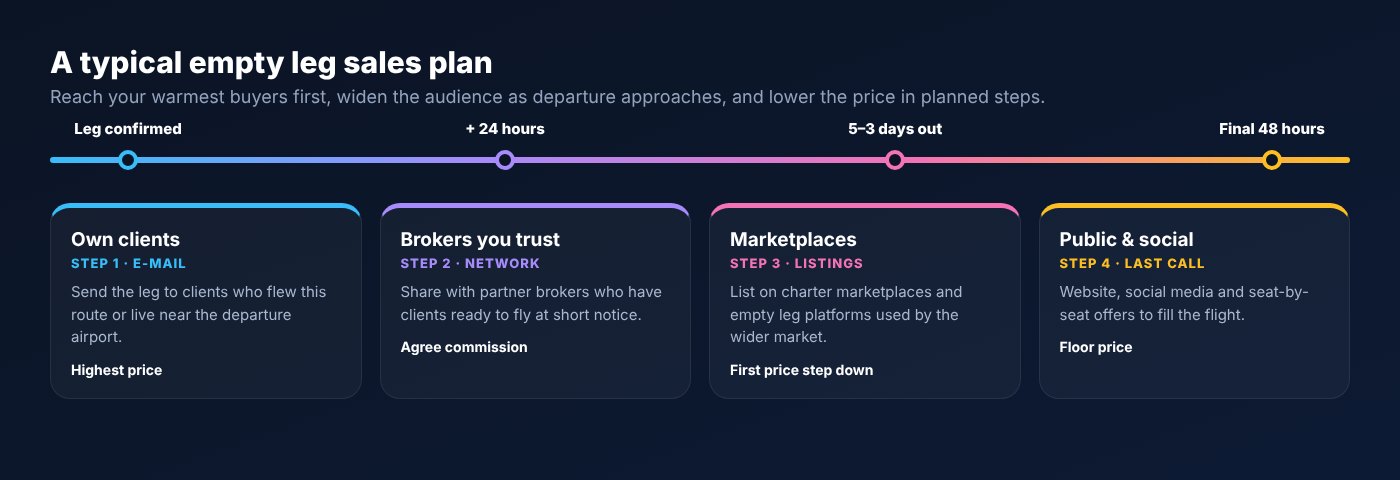
The best buyers are usually people who already know you. Clients who have flown the same route, or who live near the departure airport, convert far better than strangers. After that, partner brokers, charter marketplaces and empty leg platforms widen the audience. Business Airport International names marketplaces such as Avinode, FlyEasy and Charter Hub among those used to match empty legs with buyers.
Is it legal to sell an empty leg?
Only when the flight is operated by a company with a commercial air operator certificate, such as an FAA Part 135 certificate in the United States or an AOC in Europe. A privately operated jet generally cannot carry paying passengers. Selling seats on one is illegal charter, which can void insurance and lead to heavy penalties.
Tip for operators: treat empty legs as a marketing tool, not just a discount. A traveller who enjoys a well-run empty leg often comes back to book a full charter.
How do brokers use empty legs?
Brokers use empty legs in two ways. First, they match them to clients whose plans happen to fit, earning a commission from the operator. Second, they use attractive empty leg offers to start conversations with new clients, who may later book full charters. The key is speed: the broker who tells the right client first usually wins the booking.
Key takeaways
- An empty leg is a flight that would otherwise fly with no passengers.
- Empty legs are often sold 50–75% below a normal charter.
- The trade-off is a fixed schedule, possible cancellation and one-way travel.
- Always book with a certified operator and keep a backup plan.
- For operators, any price above the extra cost of carrying passengers beats flying empty.
- Your own clients are the best first audience for every empty leg.
Sell empty legs to the right clients automatically
Most empty legs are lost because the right client hears about them too late. In Aero Sync, you publish each leg once in Client Management, under Empty Legs, with the aircraft, route, seats and price. You can also create one straight from a scheduled flight.
From there, Automations e-mail the offer the moment you publish it. Ready-made templates send it to all your VIP clients, or to every opted-in client based within 150 nm of the departure airport. You can add filters and routers to send different messages to different groups. Every e-mail uses a branded template and is sent by Aero Sync, so there is no mailbox to connect.
To understand the direct operating costs behind your floor price, see our guide to the cost of owning a private jet.
Frequently asked questions
What is an empty leg flight?
An empty leg is a private jet flight that would otherwise fly without passengers, usually after a one-way charter or to position the jet for its next trip. Operators sell these flights at a discount.
How much cheaper are empty leg flights?
Empty legs are typically priced about 50–75% below a normal one-way charter on the same aircraft. The exact discount depends on the route, the aircraft and how close the departure is.
Are empty leg flights safe?
Yes, when the flight is operated by a certified charter operator. The aircraft, crew and safety standards are the same as on a full-price charter. Always confirm that the operator holds a commercial air operator certificate.
Can an empty leg flight be cancelled?
Yes. Because the empty leg depends on another client's trip, it can be cancelled or moved if that trip changes. Ask the operator what refund or alternative they offer, and keep a backup plan.
How far in advance are empty legs available?
Most empty legs appear a few days to two weeks before departure, once the main charter is confirmed. Repositioning flights for maintenance can be known weeks ahead.
Can I book a return flight on an empty leg?
Usually not, because empty legs are one-way flights. You can look for another empty leg in the opposite direction or book a normal one-way charter or airline ticket home.
Can I bring pets and extra luggage on an empty leg?
Often yes, but it depends on the operator, the aircraft and the destination country's rules. Confirm pets and baggage before booking, as space and policies vary.
Do empty leg flights include catering?
Some do, but many offer only basic snacks and drinks. Full catering can usually be arranged for an extra charge if there is enough notice.
Can I change the departure time of an empty leg?
Only a little, if at all. The jet must arrive in time for its next paid trip. Some operators allow a small departure window, so it is worth asking.
How do operators price empty legs?
Most start at a moderate discount for their own clients, then lower the price in steps as departure approaches. The minimum sensible price is the extra cost of carrying passengers, because the flight cost is paid either way.
Where do operators advertise empty legs?
On their own website and client e-mails first, then through partner brokers, charter marketplaces, empty leg platforms and social media.
Can a private jet owner sell an empty leg?
Only if the aircraft is operated under a commercial air operator certificate, for example by a charter operator managing the jet. Selling flights on a privately operated jet is illegal charter.