 Aero Sync

Wind rarely blows straight down the runway. Some of it pushes the aircraft sideways, and that sideways part is the crosswind. Knowing how to calculate crosswind quickly and correctly is one of the most practical skills in aviation. Student pilots need it before every solo, captains need it before every approach, and dispatchers need it for every runway at every destination. This guide covers the exact formula, two mental shortcuts, gusts, limits and how to pick the best runway.
What is crosswind?
Any wind can be split into two parts relative to the runway. The part blowing along the runway is the headwind (or tailwind if it comes from behind). The part blowing across the runway is the crosswind.
Each part affects the aircraft differently. A headwind shortens the take-off and landing roll, which is why aircraft prefer to take off and land into the wind. A tailwind lengthens both and is tightly limited. A crosswind tries to push the aircraft off the centreline. Pilots correct for it with a crab angle on approach and a wing-low technique or a de-crab just before touchdown.
The stronger the crosswind, the harder that correction becomes. Every aircraft, operator and pilot has a point beyond which a safe landing is no longer reasonable. That is why the crosswind component is calculated for every take-off and landing.
What is the crosswind formula?
The calculation uses basic trigonometry. First find the angle between the wind direction and the runway heading. Then:
Crosswind = wind speed × sin(angle)
Headwind = wind speed × cos(angle)
If the angle is more than 90°, the cosine is negative and the "headwind" becomes a tailwind.
How to calculate crosswind in four steps
- Find the runway heading. Runway 27 points roughly 270° magnetic.
- Find the wind direction. Make sure it uses the same reference as the runway, usually magnetic. More on this below.
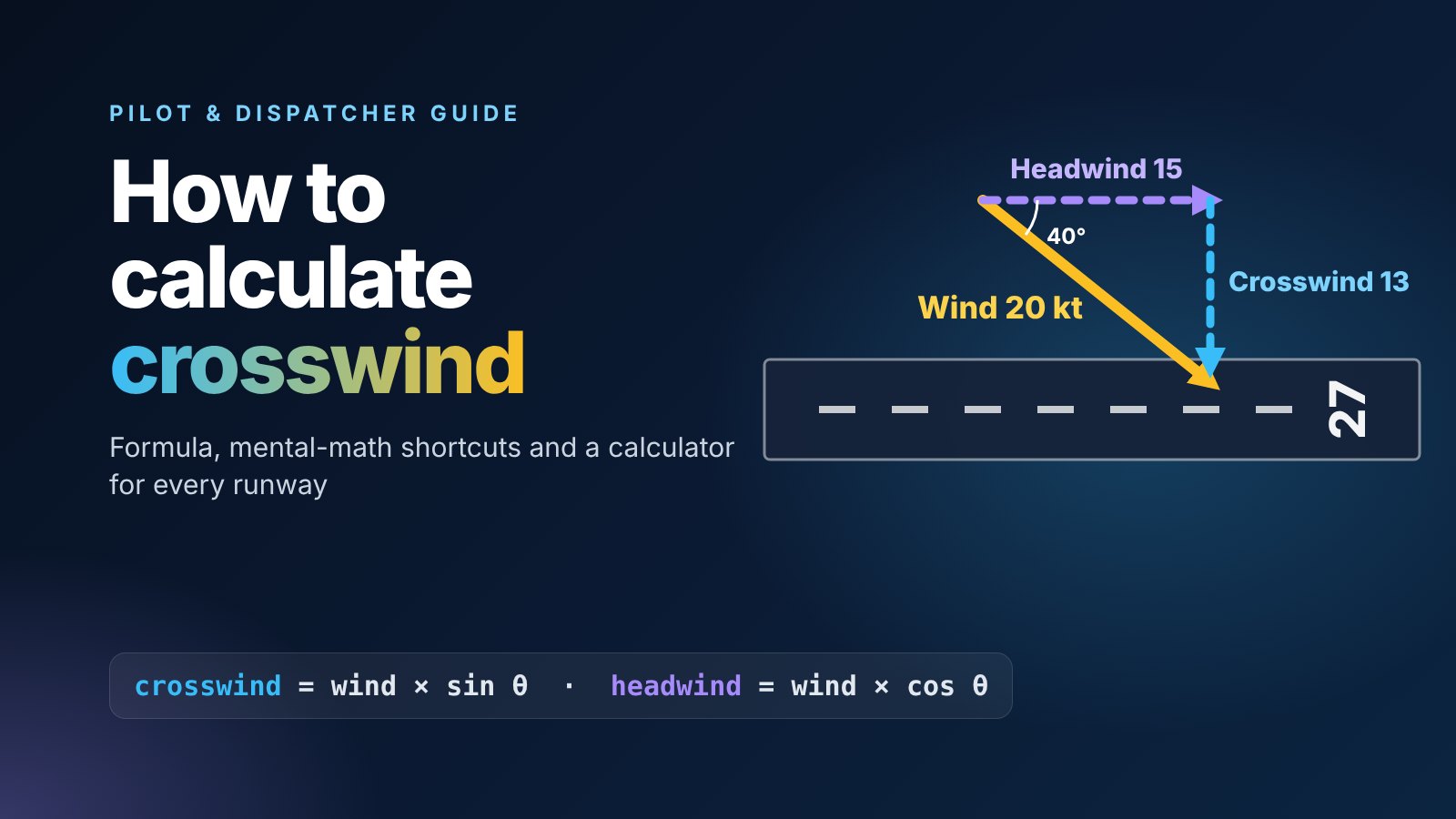
- Work out the angle. Subtract one from the other and ignore the sign. Wind 310° on runway 27 gives an angle of 40°.
- Multiply. Crosswind = wind × sin(angle). Headwind = wind × cos(angle).
Worked example: wind from the front
Runway 27, wind 310° at 20 knots, gusting 30. The angle is 40°.
- Crosswind = 20 × sin 40° = 20 × 0.64 = 12.9 knots, from the right.
- Headwind = 20 × cos 40° = 20 × 0.77 = 15.3 knots.
- Gust crosswind = 30 × 0.64 = 19.3 knots.
The gust figure is the one that matters for limits. A steady 13 knots feels comfortable, but a 19-knot gust in the flare is a very different landing.
Worked example: wind from behind
Runway 09, wind 250° at 12 knots. The angle between 090° and 250° is 160°, more than 90°, so the wind comes from behind.
- Crosswind = 12 × sin 160° = 12 × 0.34 = 4.1 knots.
- Tailwind = 12 × cos 160° = 12 × −0.94 = 11.3 knots from behind.
The crosswind is small, but 11 knots of tailwind exceeds the limit of many jets. The opposite runway, 27, would have the same crosswind and an 11-knot headwind instead.
How to calculate crosswind in your head
You will not always have a calculator, especially when the tower gives a new wind on short final. Two mental shortcuts get you within a knot or two.
The clock method
Imagine the wind angle as minutes on a clock face. Fifteen minutes is a quarter of the hour, thirty minutes is half, and so on.
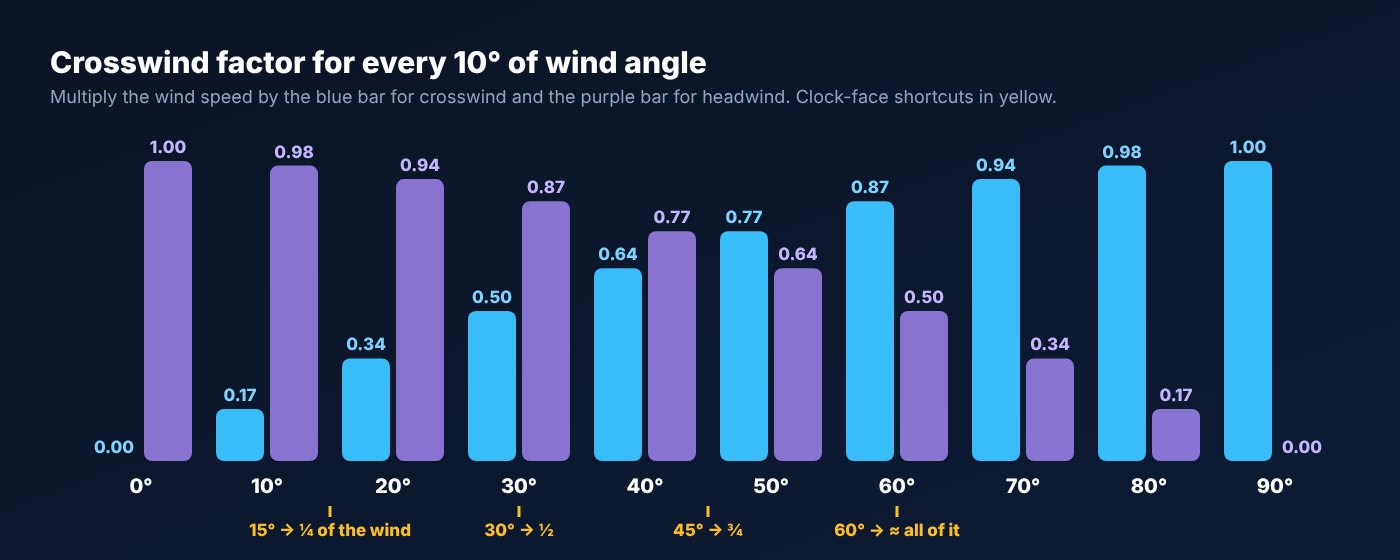
- 15° off the runway: crosswind is about ¼ of the wind speed.
- 30°: about ½.
- 45°: about ¾.
- 60° or more: treat it as the full wind speed.
For our example, 40° sits between half and three-quarters. Two-thirds of 20 knots is about 13 knots, almost exactly the true answer.
The sixty rule
For angles up to 60°, divide the angle by 60 and multiply by the wind speed. A 30° angle gives 30 ÷ 60 = 0.5, so a 20-knot wind gives 10 knots of crosswind. Up to 60°, the answer is within about a knot of the exact value for normal wind speeds. Above 60°, use the full wind speed.
| Wind angle | Crosswind factor | Headwind factor | Clock shortcut |
|---|---|---|---|
| 10° | 0.17 | 0.98 | About ⅙ |
| 20° | 0.34 | 0.94 | About ⅓ |
| 30° | 0.50 | 0.87 | ½ |
| 45° | 0.71 | 0.71 | About ¾ |
| 60° | 0.87 | 0.50 | Nearly all |
| 90° | 1.00 | 0.00 | All of it |
At 30° off the runway, half the wind is crosswind. At 60°, almost all of it is.
Try the crosswind calculator
The calculator below does the maths and shows it at the same time. The particles show the real wind flow over the runway. The arrows split the wind into headwind and crosswind. The table at the bottom works out every runway end at the airport and highlights the best one within your limits.
Which runway heading should you use?
Runway numbers are the magnetic heading rounded to the nearest 10° and divided by 10. Runway 27 could really be 266° or 274°. For a quick estimate that is close enough. For precise work, use the exact heading published on the airport chart.
Parallel runways share a number and add a letter: L for left, C for centre and R for right, as seen from the approach. The heading is the same, so the crosswind is too.
Is the wind true or magnetic?
This catches many pilots. Winds in written reports such as METARs and TAFs are given in degrees true. Winds given by ATIS and the control tower are in degrees magnetic, to match the runways. Where magnetic variation is large, mixing the two can put your angle out by 10–15°.
To convert true to magnetic, subtract an east variation or add a west one. Teterboro has a variation of about 13° west, so a METAR wind of 310° true is about 323° magnetic. The calculator above does this conversion for you. You can look up the variation for any location with the NOAA magnetic field calculator. For how wind is written in a weather report, see our guide on how to read a METAR.
How do gusts and variable winds change the calculation?
Gusts: calculate the crosswind for the gust speed as well as the steady wind, using the same angle. Most operators compare the gust crosswind with their limits, because that is what the aircraft meets at the worst moment.
Variable direction: a report such as 280V340 means the direction is swinging between 280° and 340°. Calculate the crosswind at both ends of the range and use the worse figure. On runway 27, 340° gives a 70° angle, so nearly all of the wind becomes crosswind.
VRB wind: when the direction is reported as variable, assume the full wind speed could be crosswind or tailwind. With light winds this rarely matters. With stronger variable winds near thunderstorms, it matters a lot.
Tip: when planning ahead, use the forecast wind for your arrival time from the TAF, including any TEMPO gusts. Our guide on how to read a TAF shows how to find the wind for your ETA.
What crosswind limit should you use?
There is no single limit. Several figures apply, and the lowest one wins.
| Limit | Where it comes from | What it means |
|---|---|---|
| Maximum demonstrated crosswind | Aircraft flight manual | The strongest crosswind tested during certification. In many aircraft it is guidance, not a hard limit. |
| Company limit | Operator's procedures | The operator's maximum, often reduced on wet or contaminated runways. |
| Tailwind limit | Flight manual and operator | Many jets are limited to about 10 knots of tailwind for take-off and landing. |
| Personal minimum | The pilot | A lower limit based on experience, recent practice and the type flown. |
Runway condition makes a big difference. A crosswind that is easy on a dry runway can be dangerous on a wet or icy one, because the tyres have less grip to resist the sideways push. Operators publish reduced crosswind limits for each runway condition.
Student pilots usually fly with much lower personal limits, set by their instructor. The FAA Airplane Flying Handbook explains crosswind take-off and landing techniques in detail.
How do pilots fly a crosswind landing?
Knowing the number is only half the job. The crosswind component tells you how much correction the landing will need.
The crab approach
On final approach, the pilot points the nose slightly into the wind so the aircraft tracks straight along the extended centreline while the nose points to one side. This is called crabbing. It is comfortable for passengers and keeps the wings level. Just before touchdown, the pilot uses rudder to straighten the nose with the runway, so the wheels touch down without side load.
The wing-low (sideslip) method
Many light aircraft pilots lower the upwind wing and use opposite rudder to keep the nose aligned with the runway. The aircraft lands on the upwind main wheel first. Large jets usually combine a crab with a small amount of wing-low in the flare, because their engines and wingtips limit how far a wing can be lowered.
After touchdown
The crosswind does not stop at touchdown. Pilots hold the controls into the wind during the roll-out and keep the aircraft on the centreline with rudder and nosewheel steering. On a wet or icy runway, this is where a strong crosswind becomes most dangerous.
How much drift does a crosswind cause in flight?
The same crosswind component also explains drift in cruise and on approach. A quick estimate of the wind correction angle is:
Wind correction angle (°) ≈ crosswind ÷ true airspeed × 60
For example, a 13-knot crosswind at an approach speed of 130 knots needs about 13 ÷ 130 × 60 = 6° of crab. The same 13 knots at a cruise speed of 450 knots needs less than 2°. That is why crosswind matters so much more at low speeds.
How do dispatchers choose the best runway?
Air traffic control decides which runway is in use, but dispatchers and crews still check every option. A good choice has a headwind, a crosswind well within limits and enough runway length. Noise rules, approach types and taxi distances also play a part.
- List every runway end at the destination and the alternate.
- Calculate headwind or tailwind and crosswind for each, including gusts.
- Remove runways where the tailwind or gust crosswind exceeds the limits.
- Prefer the runway with the most headwind and the least crosswind.
- Check that the runway length works for the conditions, especially if it is wet.
If no runway is within limits at the arrival time, the decision is simple: delay, hold for better wind or plan a diversion.
Common mistakes: mixing true and magnetic wind directions, ignoring the gust crosswind, forgetting that angles over 90° mean a tailwind, using an old wind report on approach, and averaging a variable wind instead of using the worst case.
Key takeaways
- Crosswind = wind × sin(angle). Headwind = wind × cos(angle).
- The clock method gives a fast estimate: 15° = ¼, 30° = ½, 45° = ¾, 60°+ = all.
- Use the same reference for wind and runway. Written reports are true, ATIS and tower are magnetic.
- Always check the gust crosswind and the tailwind against your limits.
- Compare every runway end to find the best one for the conditions.
Crosswind for every runway, automatically
Working through every runway by hand takes time. The Aero Sync Aviation Weather tool fetches the live METAR and TAF for an airport and shows the headwind, tailwind and crosswind for each runway, with optional aircraft limits.
Frequently asked questions
How do you calculate crosswind?
Find the angle between the wind direction and the runway heading, then multiply the wind speed by the sine of that angle. For example, a 20-knot wind at 40° to the runway gives 20 × 0.64 = about 13 knots of crosswind.
What is the crosswind formula?
Crosswind = wind speed × sin(angle) and headwind = wind speed × cos(angle), where the angle is the difference between the wind direction and the runway heading.
What is the clock method for crosswind?
It treats the wind angle like minutes on a clock: 15° gives about a quarter of the wind as crosswind, 30° about half, 45° about three-quarters and 60° or more the full wind speed.
How do you calculate headwind?
Multiply the wind speed by the cosine of the angle between the wind and the runway. If the angle is greater than 90°, the result is negative, which means a tailwind.
How do you calculate crosswind with gusts?
Use the same angle and multiply the gust speed by the sine of the angle. Compare this gust crosswind with your limits, because it is the strongest crosswind you will meet.
Is the wind in a METAR true or magnetic?
METAR and TAF winds are given in degrees true. ATIS and tower winds are given in degrees magnetic, to match the runway headings. Convert before calculating if the variation is large.
What is maximum demonstrated crosswind?
It is the highest crosswind component tested during the aircraft's certification and shown in its flight manual. In many aircraft it is not a legal limit, but operators and pilots often use it as a basis for their own limits.
What crosswind can a business jet handle?
It depends on the type. Many business jets have demonstrated crosswinds in the 20s of knots, but company limits, runway condition and pilot experience often reduce the practical limit.
What is a typical tailwind limit?
Many jets are limited to about 10 knots of tailwind for take-off and landing, although some are approved for more. Always check the aircraft flight manual and your operator's rules.
What happens when the wind is at 90° to the runway?
At 90°, the whole wind is crosswind and there is no headwind or tailwind. A 15-knot wind at 90° gives a 15-knot crosswind.
Does the runway number give the exact heading?
No. The runway number is the magnetic heading rounded to the nearest 10°. For precise calculations, use the exact heading from the airport chart.