 Aero Sync

The purchase price is only the entry ticket. The real cost of owning a private jet arrives every month afterwards: crew, hangar, insurance, maintenance, fuel and the slow loss of value. This guide breaks those costs into fixed and variable items, gives a full annual budget for three sizes of jet, and shows how to bring the cost per hour down.
About the numbers: the budgets in this article are an illustrative model built from published industry ranges. Real costs vary widely with the aircraft, its age, where it is based and how it is operated. Use them as a starting point, then build your own budget with your management company and advisers.
How much does it cost to own a private jet? The quick answer
If you only have a minute, this table gives the short answer. Each jet flies 300 hours a year. The rest of the guide explains every number.
| At a glance | Light jet | Super-midsize | Large-cabin |
|---|---|---|---|
| Example models | Phenom 300E, Citation CJ4 | Challenger 3500, G280 | Global 7500, G700 |
| Example value | $9M | $22M | $60M |
| Operating cost per year | $1.4M | $2.5M | $4.8M |
| Operating cost per month | $118,000 | $204,000 | $400,000 |
| Variable cost per flight hour | $2,070 | $3,800 | $6,820 |
| True cost per year (incl. value loss and capital) | $2.4M | $4.9M | $11.4M |
| All-in cost per flight hour | $8,020 | $16,230 | $37,990 |
Fixed vs variable costs: what is the difference?
Every private jet cost falls into one of two groups. Fixed costs stay the same however much you fly, like rent on a house. Variable costs go up with every hour in the air, like fuel in a car.
The split matters because it decides your real cost per hour. A jet with high fixed costs and low use is very expensive per hour. The same jet flown often becomes far more reasonable.
What are the fixed costs of owning a private jet?
Fixed costs are the bills you pay whether the jet flies 50 hours or 500. They are why a jet that sits in the hangar is so expensive.
Crew salaries and benefits
Crew is usually the largest fixed cost. A light jet typically needs two pilots, while a large-cabin jet flying long trips often needs four pilots and a flight attendant. According to The Flying Engineer, captains earn roughly $80,000 to more than $200,000 a year. Benefits and payroll taxes add another 30–40%.
Training
Every pilot needs recurrent simulator training on your aircraft type, usually once a year. Larger and more complex jets have more expensive courses. Many owners also train cabin crew in safety and service.
Hangar
A heated hangar protects the aircraft and its interior. Costs depend heavily on location. A small jet at a regional airport costs far less than a large-cabin jet at a busy airport near a major city.
Insurance
Insurance covers the aircraft itself (hull) and liability to passengers and third parties. The premium depends on the jet's value, pilot experience, where you fly and your claims history. For most owners it runs from tens of thousands to several hundred thousand dollars a year.
Management and administration
Most owners hire a management company to employ the crew, plan maintenance, handle regulation and pay the bills. This is usually charged as a monthly fee. Some owners run their own flight department instead, which moves the cost into staff and office overheads.
Scheduled inspections and subscriptions
Many inspections are due by calendar time, not flight hours, so they behave like a fixed cost. Add navigation databases, flight-planning software, weather services and in-flight connectivity. Together these can easily reach six figures a year.
Refurbishment reserve
Paint and interiors wear out. Setting money aside each year for a refurbishment every five to seven years avoids an unpleasant surprise and protects resale value.
What are the variable costs of flying a private jet?
Variable costs rise with every hour flown. Industry quotes for "cost per hour" usually mean these costs only, which is why they look much lower than the true cost of ownership.
- Fuel is the largest variable cost. A light jet burns roughly 150–170 gallons an hour and a large-cabin jet 450 gallons or more. Prices vary a lot by airport and country.
- Engine programmes charge a fixed rate per engine for every flight hour. In return they cover overhauls and most engine repairs.
- Airframe maintenance covers hourly inspections, parts and unscheduled repairs.
- Landing, handling and navigation fees are charged at each airport and by air traffic services.
- Crew travel covers hotels, meals and transport on trips.
- Catering and cabin supplies depend on your trips and passengers.
Tip: engine programmes look expensive per hour, but they turn a sudden overhaul bill of several million dollars into a smooth hourly cost. Aircraft enrolled on a programme also usually sell faster and for more.
What is the cost of owning a private jet per year?
Here is a full annual budget for three typical sizes of jet, each flying 300 hours a year. Fuel is priced at $6.50 a gallon.
| Fixed costs per year | Light jet ($9M) | Super-midsize ($22M) | Large-cabin ($60M) |
|---|---|---|---|
| Crew salaries and benefits | $325,000 | $430,000 | $1,080,000 |
| Recurrent training | $50,000 | $80,000 | $180,000 |
| Hangar | $60,000 | $120,000 | $200,000 |
| Insurance | $50,000 | $120,000 | $250,000 |
| Management | $120,000 | $180,000 | $300,000 |
| Charts, flight planning, connectivity | $30,000 | $50,000 | $90,000 |
| Calendar inspections | $120,000 | $250,000 | $500,000 |
| Refurbishment reserve | $40,000 | $80,000 | $150,000 |
| Total fixed | $795,000 | $1,310,000 | $2,750,000 |
| Variable costs per hour | Light jet | Super-midsize | Large-cabin |
|---|---|---|---|
| Fuel | $1,040 (160 gal) | $1,690 (260 gal) | $3,120 (480 gal) |
| Engine programme | $300 | $760 | $1,300 |
| Airframe and unscheduled maintenance | $300 | $600 | $1,000 |
| Landing, handling, navigation fees | $250 | $400 | $700 |
| Crew travel | $150 | $250 | $400 |
| Catering and supplies | $30 | $100 | $300 |
| Total per hour | $2,070 | $3,800 | $6,820 |
At 300 hours, the variable costs add $621,000, $1.14 million and $2.05 million a year. That gives annual operating costs of about $1.4 million for the light jet, $2.5 million for the super-midsize and $4.8 million for the large-cabin jet. These totals sit within the ranges reported by operators to NovaJet.
What costs do most owners forget?
Operating costs are only part of the picture. Two more costs never arrive as an invoice, but they are just as real.
Loss of value
Most jets lose value every year. New business jets lost about 9.4% a year on average over their first five years. Older aircraft usually lose value more slowly. Our model uses 6% a year, which on a $22 million jet is $1.32 million, more than its entire fixed operating budget.
Cost of capital
Money tied up in a jet cannot earn a return elsewhere. At 5% a year, a $22 million aircraft gives up $1.1 million of income. If you financed the jet, the interest you pay is this cost.
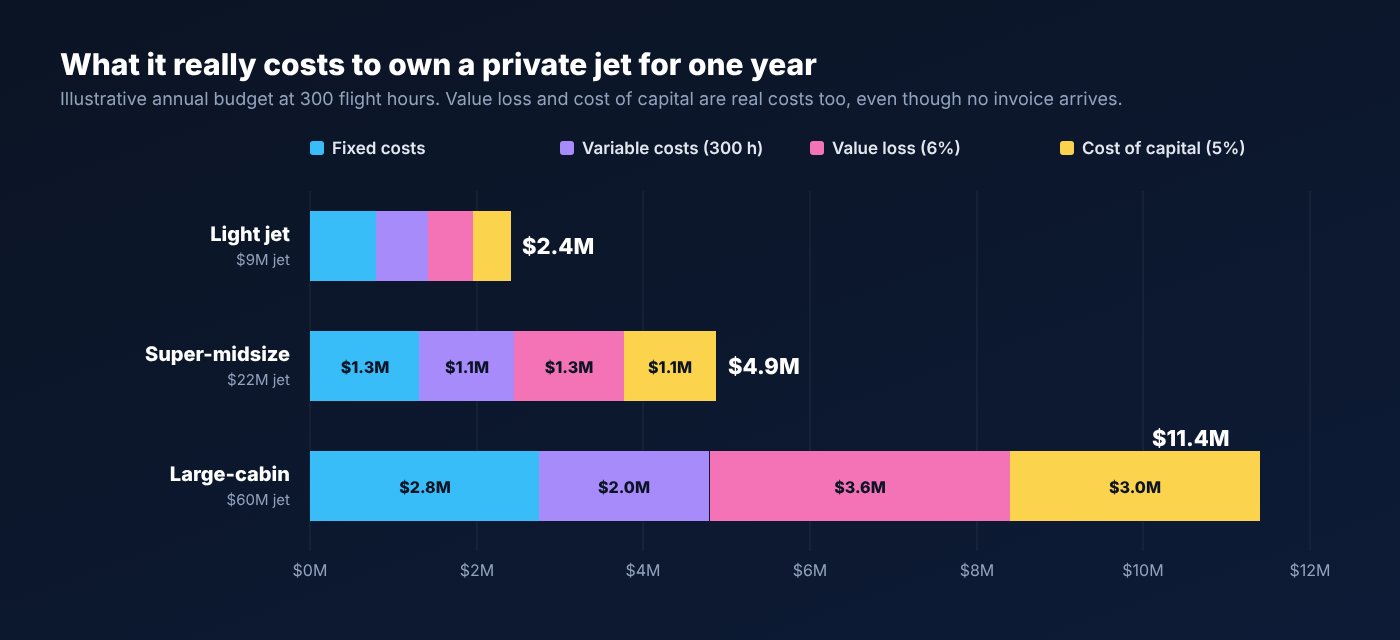
| Full annual cost at 300 hours | Light jet | Super-midsize | Large-cabin |
|---|---|---|---|
| Fixed operating costs | $0.80M | $1.31M | $2.75M |
| Variable operating costs | $0.62M | $1.14M | $2.05M |
| Value loss (6% a year) | $0.54M | $1.32M | $3.60M |
| Cost of capital (5% a year) | $0.45M | $1.10M | $3.00M |
| True cost of ownership | $2.4M | $4.9M | $11.4M |
| Operating cost per hour | $4,720 | $8,170 | $15,990 |
| All-in cost per hour | $8,020 | $16,230 | $37,990 |
A private jet's advertised hourly cost is rarely the real one. Add fixed costs, value loss and capital, and the true hourly cost is often four times higher.
How does flying more change your cost per hour?
Fixed costs, value loss and capital do not depend on how much you fly. Spread over more hours, each hour gets cheaper. This is the single most important lever on the cost of owning a private jet.
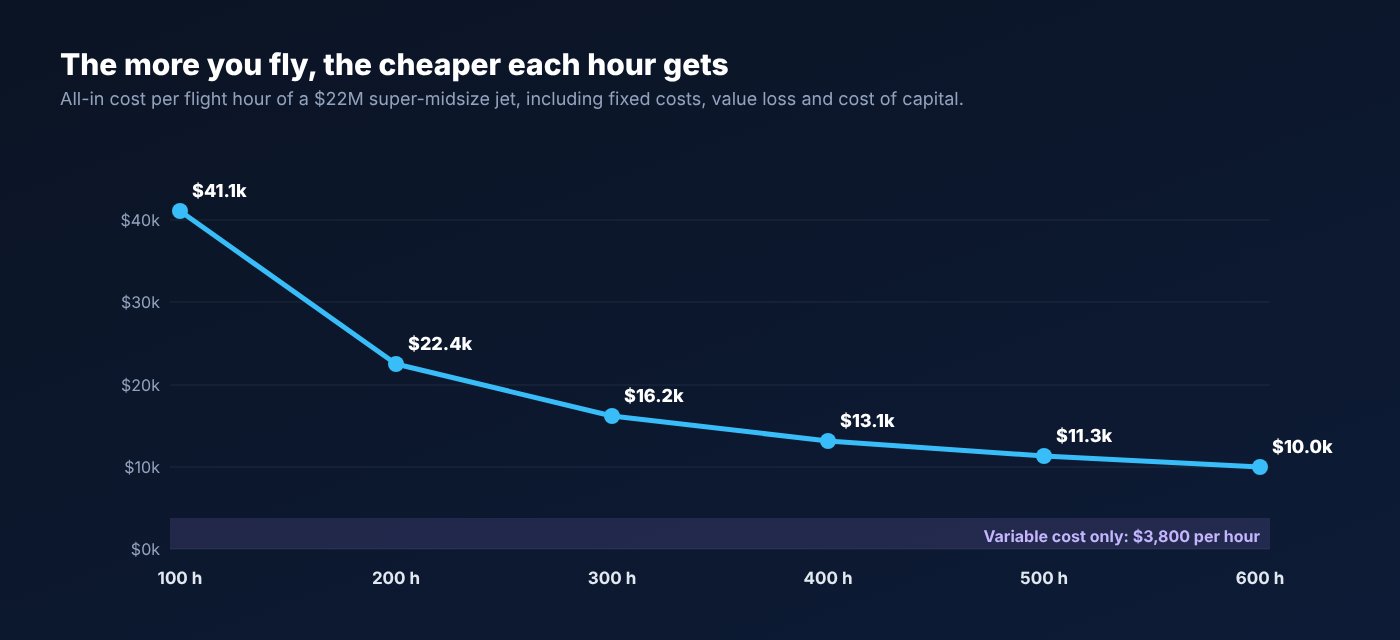
At 100 hours a year, each hour of the super-midsize jet really costs about $41,000. At 400 hours, it falls to about $13,000. That is why low-use owners should compare whole ownership with charter, jet cards and fractional shares before they buy.
How do flight departments calculate the true cost per hour?
Professional flight departments and aircraft managers use one simple formula. It works for any aircraft and any number of hours.
All-in cost per hour = (fixed costs + value loss + cost of capital) ÷ flight hours + variable cost per hour.
Example: for the super-midsize jet, ($1.31M + $1.32M + $1.10M) ÷ 300 hours + $3,800 = $16,230 per hour.
Experts also compare aircraft by unit cost. Cost per seat-hour shows the cost of one passenger seat for one hour. Cost per nautical mile shows how much distance each dollar buys. Bigger jets cost more per hour, but they carry more people further.
| Unit costs (all-in, 300 h) | Light jet | Super-midsize | Large-cabin |
|---|---|---|---|
| Typical seats | 7 | 9 | 14 |
| Cost per seat-hour | $1,146 | $1,803 | $2,714 |
| Average block speed (assumed) | 350 kt | 420 kt | 450 kt |
| Cost per nautical mile | $23 | $39 | $84 |
For budgeting, many managers also separate direct operating costs (the variable costs above) from indirect costs (fixed costs and overheads). Charter rates and engine programme quotes are usually based on direct costs only, so check which one you are comparing.
How can you reduce the cost of owning a private jet?
- Fly the right amount. If you fly fewer than about 150–200 hours a year, compare other ways of flying first.
- Choose the right size. Buy for your typical trip, not your longest one. Charter a bigger jet for the occasional long mission.
- Pick a model that holds its value. Popular, well-supported aircraft lose value more slowly, which is often the biggest saving of all.
- Use engine and maintenance programmes. They smooth costs and protect resale value.
- Plan fuel. Prices differ widely between airports. Fuel contracts and buying fuel where it is cheaper can save thousands a month.
- Consider charter revenue carefully. Putting the jet on a charter certificate can offset fixed costs. It also adds wear, reduces availability and can change your tax position.
- Keep perfect records. Complete maintenance and flight logs make the jet easier to sell and protect any tax deductions.
Watch for hidden costs: empty positioning flights, crew overnights, de-icing, international permits and fees, avionics upgrades required by new rules, and unscheduled repairs away from base. Keep a contingency of at least 10% of your operating budget.
Private jet cost terms explained
New to aircraft ownership? These are the terms you will hear most often.
| Term | What it means |
|---|---|
| Fixed costs | Costs you pay whether or not the jet flies, such as crew, hangar and insurance. |
| Variable costs | Costs that rise with each flight hour, such as fuel and maintenance. |
| Direct operating cost (DOC) | The variable cost per flight hour. Often quoted as the jet's "hourly cost". |
| Engine programme | An hourly fee paid to cover future engine overhauls and repairs. |
| Residual value | What the jet is worth when you sell it. |
| Cost of capital | The return your money could have earned if it were not tied up in the jet. |
| Positioning flight | A flight with no passengers, for example to pick them up or return home. |
| Part 91 / Part 135 | US rules for private flights and for paid charter flights. |
| Block time | Time from leaving the gate to arriving at the destination gate. |
Key takeaways
- Fixed costs, such as crew, hangar, insurance and management, are paid even when the jet does not fly.
- Variable costs, led by fuel and maintenance, rise with every flight hour.
- Value loss and cost of capital are often as large as all operating costs combined.
- A $22 million super-midsize jet flying 300 hours costs about $4.9 million a year all-in.
- The more hours you fly, the lower your true cost per hour.
How to build your own private jet budget
Every owner's numbers are different, so build a budget for your exact aircraft and missions. Aero Sync has the tools to do it in minutes.
- The Trip Cost & Range Planner prices real trips with fuel, crew and fees, and checks the jet can fly them.
- The Depreciation Calculator shows how much value your jet is likely to lose each year.
- Charter vs Card vs Own compares ownership with charter, jet cards and fractional shares at your flying hours.
Still deciding how to pay for the aircraft? Read our guide on lease vs buy for private jets, or test your own case with the Lease vs Buy calculator.
Frequently asked questions
How much does it cost to own a private jet per year?
Operating costs typically range from about $1 million a year for a light jet to $5 million or more for a large-cabin jet. Including value loss and cost of capital, the true cost can be roughly twice the operating cost. In our model, a $22 million super-midsize jet flying 300 hours costs about $2.5 million to operate and $4.9 million all-in.
How much does a private jet cost per hour to fly?
Variable costs alone are roughly $2,000 an hour for a light jet and $7,000 or more for a large-cabin jet. Once fixed costs, value loss and capital are included, the all-in cost per hour is often three to five times higher, especially if the jet flies few hours.
How much does a private jet cost per month?
In our model, monthly operating costs are about $118,000 for a light jet, $204,000 for a super-midsize jet and $400,000 for a large-cabin jet. Many costs, such as inspections and insurance, are paid in large amounts a few times a year, so plan with an annual budget.
What is the biggest cost of owning a private jet?
For many owners, the biggest single cost is the loss of the aircraft's value over time. Among operating costs, crew salaries are usually the largest fixed cost and fuel the largest variable cost.
How much do private jet pilots cost?
Captains typically earn from about $80,000 to more than $200,000 a year, and first officers about $60,000 to $150,000. Benefits and payroll taxes add around 30–40%. Most jets need at least two pilots, and busy or long-range jets need more.
How much does private jet insurance cost?
Most owners pay from about $60,000 to more than $300,000 a year. The premium depends on the jet's value, the pilots' experience, where you fly and your claims history.
How much does a private jet hangar cost?
Hangar costs range from tens of thousands of dollars a year at regional airports to $150,000 or more for a large jet at a busy airport near a major city.
How much does private jet maintenance cost per year?
Owner-reported estimates range from about $300,000 to $700,000 a year for a light jet, $1–2 million for a super-midsize jet and $2–4 million or more for a heavy jet, including engine programmes. Newer aircraft under warranty usually cost less.
Is it cheaper to charter than to own a private jet?
For people who fly fewer than about 150–200 hours a year, charter, jet cards or fractional ownership are often cheaper. Ownership becomes more competitive as flying hours rise, because fixed costs are spread over more hours.
How many hours a year do you need to fly to justify owning a jet?
There is no single number, but many advisers start to recommend whole ownership somewhere above 200 hours a year. Below that, the fixed costs make each hour very expensive. Control, privacy and availability can still justify ownership for some owners.
Can you make money by chartering out your private jet?
Charter income can offset part of the fixed costs, but most owners do not make a profit from it. It adds wear and maintenance, reduces when the jet is available to you and can change your tax position.
Do private jets lose value?
Most private jets lose value every year. New business jets have lost about 9.4% a year on average in their first five years, according to Cirium. Older aircraft usually lose value more slowly, and popular, well-supported models hold value best.
What is the cheapest private jet to own?
Very light and single-engine jets have the lowest ownership costs, because they burn less fuel, need smaller hangars and can sometimes be flown by one pilot. They also have smaller cabins and shorter range.
Does financing a private jet change the cost?
Financing replaces part of the cost of capital with interest payments. If your loan rate is lower than what your money earns elsewhere, financing can lower the true cost. Leasing moves the value-loss risk to the lessor in exchange for a monthly rent.