 Aero Sync

A jet engine maintenance program is a contract in which an owner pays the engine manufacturer, or an independent provider, a fixed rate for every hour the engine runs, and in return the provider pays for the inspections, overhauls and many of the unplanned repairs that the engine will need over its life.
On a business jet the engines are often the most expensive maintenance item on the aircraft, so whether you are enrolled or paying as you go changes cash flow, resale value and how much risk you carry. This guide explains how hourly engine programs work, what they cover, how a pay-as-you-go owner should hold reserves, why buyers deduct unfunded engine time at sale, and when staying out can make sense. A 10-year simulator lets you test your own numbers.
Scope: rates, intervals and shop-visit costs in this article are illustrative round numbers, not quotes. Every engine type, program tier and contract is different, so use your own proposal and your maintenance provider's figures for real decisions.
What is a jet engine maintenance program?
Think of it as a prepaid maintenance plan priced per hour. Instead of paying nothing for years and then a very large invoice when an inspection or overhaul falls due, the owner pays a predictable amount for each engine flight hour (EFH). The provider pools the money from many engines of the same type and takes on the job of funding shop visits when they arrive.
The best-known programs are run by the engine manufacturers (the original equipment manufacturers, or OEMs):
- Rolls-Royce CorporateCare for engines such as the BR710, BR725 and Pearl family. Rolls-Royce describes its enhanced CorporateCare cover as extending beyond the engine to expanded line maintenance and nacelle components such as the thrust reverser and cowls.
- Honeywell Maintenance Service Plan (MSP) for engines such as the HTF7000 and TFE731.
- Pratt & Whitney Canada Eagle Service Plan (ESP) for the PW300, PW500 and PW600 families.
- GE OnPoint and Williams International TAP plans for their respective engines.
Independent providers also sell hourly programs that are not tied to one manufacturer. Whichever provider you choose, the economics follow the same pattern explained below.
Key terms in simple words
Engine contracts are full of abbreviations. Here are the ones you need, each spelled out once:
- Engine flight hour (EFH): one hour of engine operation as defined in the contract, usually measured from take-off to landing or from engine start to shutdown. Programs bill per EFH, per engine.
- Time between overhaul (TBO): the recommended interval, in hours, after which the engine is removed and fully overhauled.
- Time since overhaul (TSO): hours flown since the last overhaul. Brokers quote it when listing aircraft.
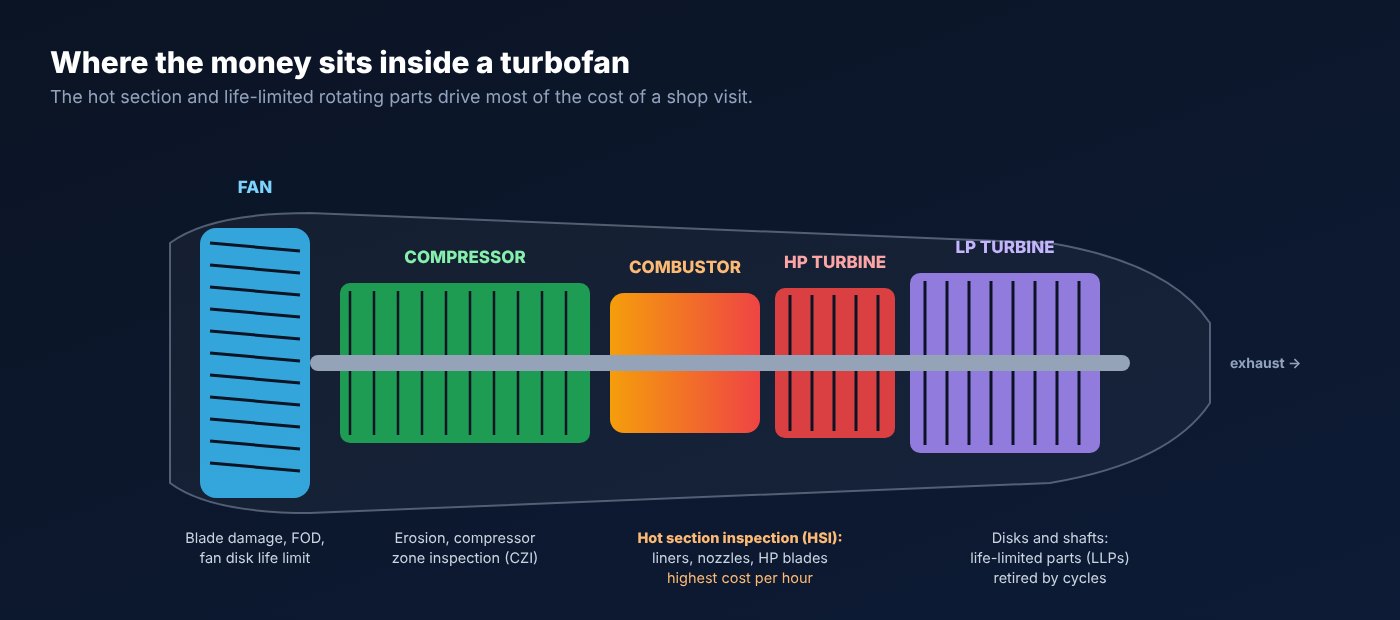
- Hot section inspection (HSI): an inspection of the combustor and turbine, where the engine is hottest and wear is fastest.
- Major periodic inspection (MPI) and core zone inspection (CZI): scheduled inspections between overhauls on some engine types, often the "mid-life" shop visit owners talk about.
- Life-limited part (LLP): a rotating part, such as a turbine disk or shaft, that must be retired after a certain number of cycles regardless of condition. Engine certification rules such as 14 CFR Part 33 require these limits to be set.
- Cycle: one start, take-off and landing sequence. Short flights use up cycles faster per hour flown.
How does an hourly engine program work?
The mechanics of a jet engine maintenance program are simple, but the details decide whether the deal is good. Six elements matter:
- The hourly rate. A rate per EFH, per engine. A twin-engine jet flying 400 hours a year at $300 per EFH pays 400 × 2 × $300 = $240,000 a year.
- Annual escalation. Rates normally rise every year, often linked to the provider's parts price list or an inflation index. Ask whether there is a cap.
- Minimum annual hours. Many contracts bill a minimum number of hours per year even if you fly less. A low-utilisation owner can end up paying for hours never flown.
- Buy-in. An engine that joins a program part-way through its life must pay for the time already used since the last shop visit, because the provider is taking on a liability that is already partly built up. Pratt & Whitney explains in its Airtime article on buy-in that even freshly overhauled engines can require a buy-in, mainly because life-limited parts carry their own cycle clocks of roughly 7,000 to 15,000 cycles.
- Transferability. Program coverage usually stays with the engine when the aircraft is sold, which is the main reason enrolled aircraft are easier to sell.
- Tiers. Providers sell several levels of cover. Honeywell's MSP for propulsion, for example, separates its tiers by whether life-limited parts, freight and removal and installation of line-replaceable units are included.
Pooling explained: the provider is effectively running an insurance pool. Each owner pays a smooth rate, and the pool pays the large and uneven shop-visit bills. You pay a margin for that service, but you also hand over the risk of a bad shop visit, a failed part or a cost increase.
What does a jet engine maintenance program cover?
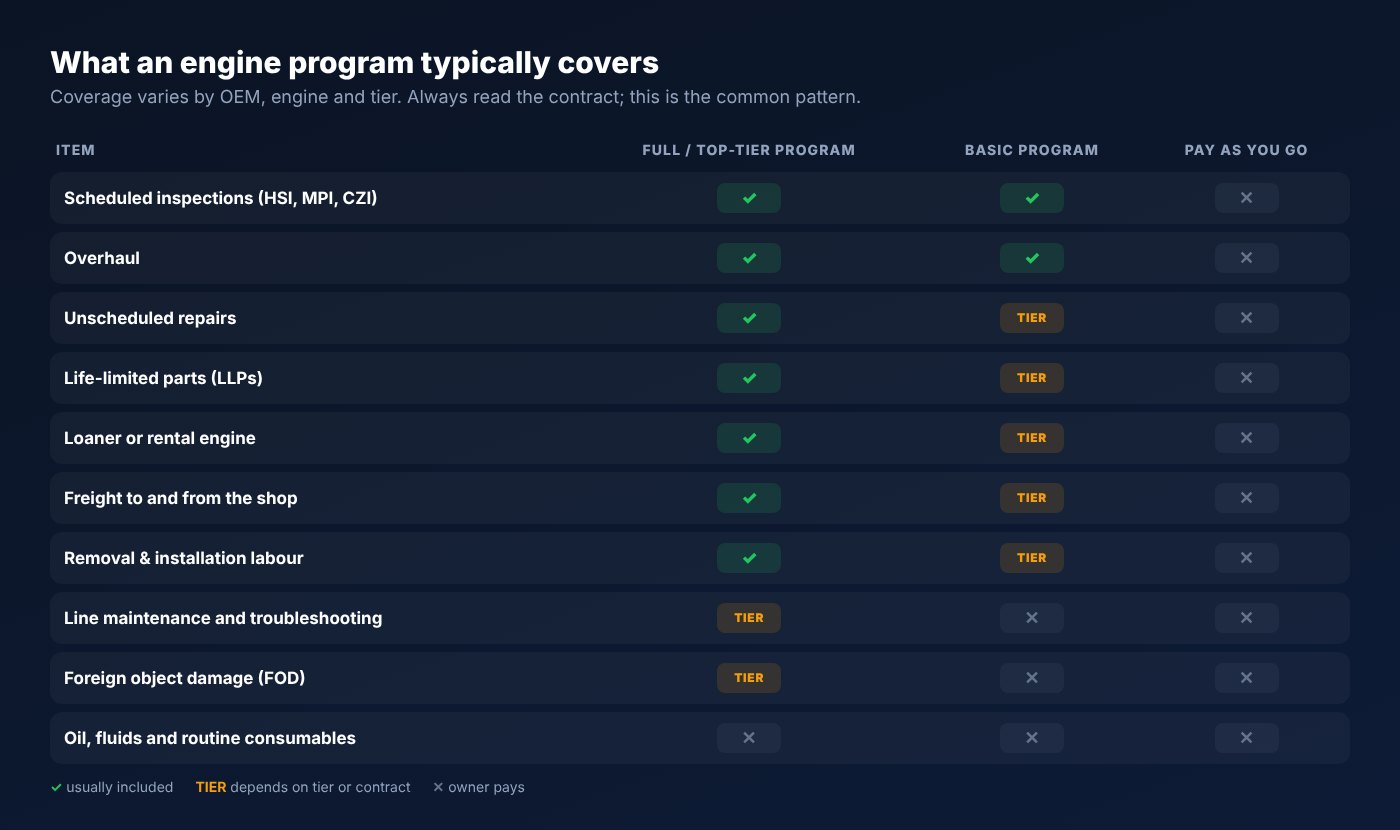
Coverage is where contracts differ most. A top-tier plan comes close to "bumper-to-bumper" for the engine, while a basic plan may cover only scheduled events. Typical patterns look like this:
Items that commonly cause disputes:
- Foreign object damage (FOD). Some plans cover FOD fully, some only above a deductible, some not at all.
- Loaner or rental engines. If an engine is removed for an unscheduled repair, who pays for a rental engine and its shipping matters as much as the repair itself.
- Accessories and line-replaceable units (LRUs). Fuel controls, starters and generators may be inside or outside the cover.
- Consumables and fluids. Oil and routine consumables are usually excluded everywhere.
- Misuse and operation outside limits. Over-temperature events and operation outside the manual are typically excluded.
Pay as you go and engine reserves
An owner who is not enrolled is "pay as you go" (PAYG). Nothing is paid between events, then the full cost of each shop visit is paid when it is due. A disciplined PAYG owner sets aside a reserve every hour so the money is there when the overhaul arrives.
The reserve per hour is simple arithmetic: divide the expected cost of each event by its interval, then add an allowance for unscheduled repairs.
| Event (per engine) | Illustrative cost | Interval | Reserve per EFH |
|---|---|---|---|
| Mid-life inspection (MPI or HSI) | $300,000 | 3,500 h | $86 |
| Overhaul | $750,000 | 7,000 h | $107 |
| Unscheduled repairs (average) | — | — | $40 |
| Total reserve | $233 |
Compare that with a program rate of, say, $300 per EFH. The difference of about $67 per hour is the price of transferring risk, plus the provider's margin. Whether it is worth paying depends on how lumpy your costs are, how long you keep the aircraft and what a buyer will pay for it.
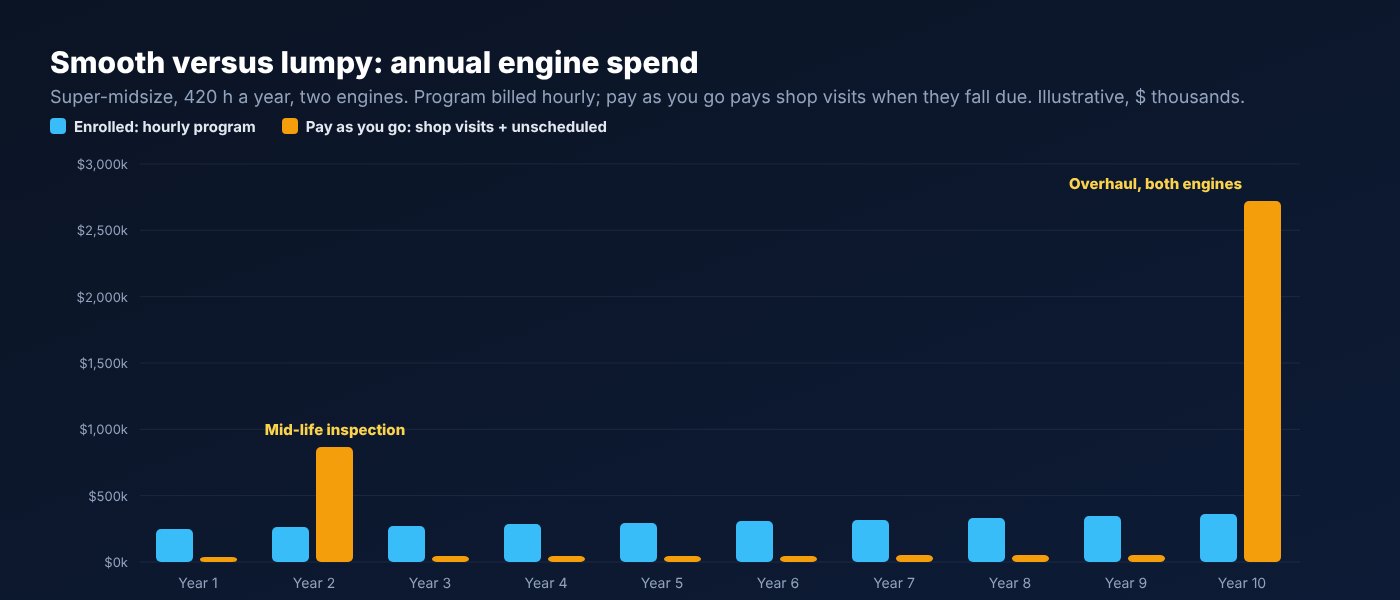
An engine program does not make shop visits cheaper. It makes them predictable, and it makes the aircraft easier to sell.
Enrolled vs pay as you go: 10-year simulator
Use the simulator to compare a jet engine maintenance program against pay as you go over ten years. Choose a preset or enter your own rates, intervals and costs. Switch between "stay vs leave" for an enrolled engine and "join vs stay out" for an engine that is not yet on a program; leave the buy-in empty to have it estimated from the time already used.
The shaded band shows the 10th to 90th percentile range of PAYG cost from 600 simulated futures with random unscheduled events, and the sale option adds the deduction a buyer would make for unfunded engine time.
Things to try: lower the hours per year and watch the minimum billed hours change the answer; untick "sell at year 10" to see how much of the program's advantage comes from resale; and move the time since overhaul to see how close the next big event is.
The unfunded liability when you sell
This is the part many first-time owners miss. When a PAYG aircraft is sold, the buyer's broker calculates how much engine life has been "used up" since the last shop visits and deducts it from the price. The logic is that the buyer will have to pay for that wear when the next event arrives.
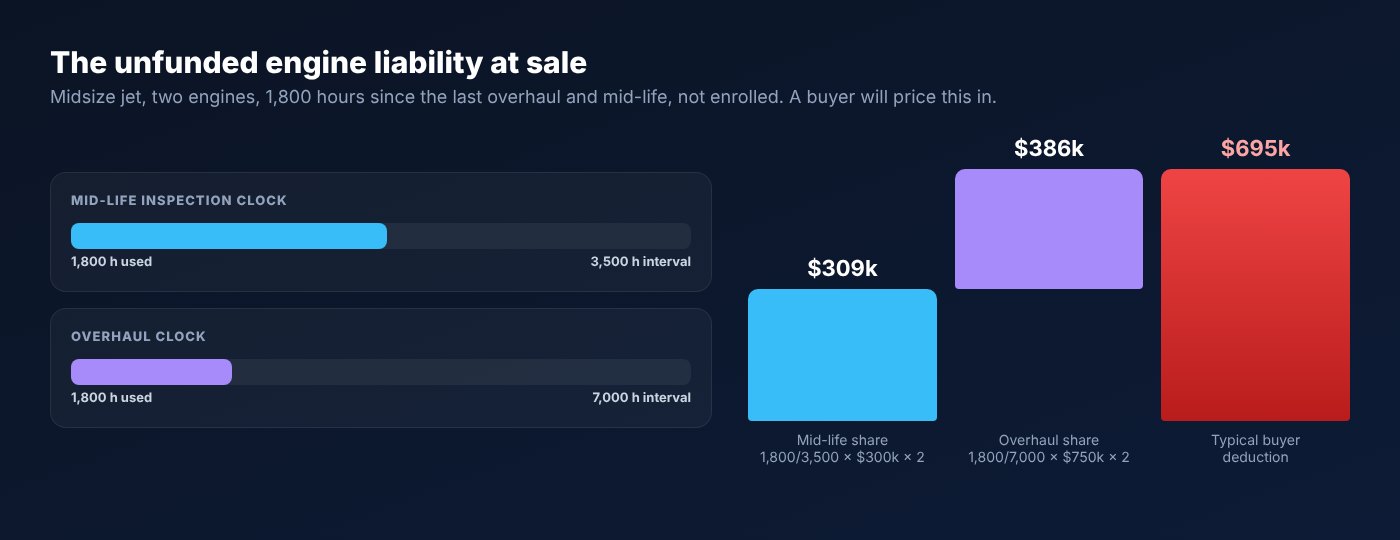
Brokers have been consistent on this for years. A Corporate Jet Investor survey of brokers found that the overwhelming majority would advise owners to enrol, and quoted brokers who say buyers simply deduct the value of the missing enrolment from their offer. In practice an unenrolled aircraft also has a smaller pool of buyers, because many financiers and lessors prefer or require program coverage.
The deduction is not always the full accrued figure, and in a strong market sellers recover some of it. But planning for the full amount is the safer assumption.
When can pay as you go make sense?
A jet engine maintenance program is not automatically the right answer. PAYG can be reasonable when:
- The engines are freshly overhauled and you plan to sell well before the next major event. Little liability builds up, although buy-in rules for life-limited parts can still apply later.
- Utilisation is very low and minimum billed hours would make you pay for hours you never fly. Calendar-limited items still need funding, so keep a reserve.
- The aircraft type is not commonly enrolled, so buyers do not expect it and the resale penalty is smaller.
- You fly long legs with a high hour-to-cycle ratio, which uses up life-limited parts slowly per hour flown.
- You have strong cash reserves and a maintenance provider you trust to manage shop visits competitively.
The common thread is that PAYG works for owners who can absorb a large bill and either keep the aircraft to the end of the engine's cycle or sell when little liability has built up.
Leaving a program, leases and reserves
Leaving a program mid-life is rarely cheap. Hours already paid into the pool normally stay with the provider, so the owner forfeits the value of the accrual and then has to fund the next shop visit alone. If the aircraft is later re-enrolled, a new buy-in applies.
Leased aircraft follow a similar logic. Lessors normally require either program enrolment or monthly maintenance reserves paid into an account, so the engine liability is funded either way. If you are weighing ownership structures, the trade-offs are covered in our guide to leasing versus buying a private jet, and the wider budget in the cost of owning a private jet.
Questions to ask before signing a jet engine maintenance program
- Exactly which tier is quoted, and which items in the coverage matrix are inside it?
- How is the annual escalation calculated, and is there a cap?
- What are the minimum billed hours, and can unused hours roll over?
- How was the buy-in calculated, especially for life-limited parts?
- Is FOD covered, and with what deductible?
- Is a rental engine guaranteed, and who pays freight and installation?
- What happens on sale: is transfer automatic, and is there a fee?
- What are the exit terms, and is any accrued value refundable?
- Does the plan require shop visits at specific facilities?
Read the exclusions first. Two programs at the same hourly rate can be very different products. Compare tiers line by line, not just the rate per EFH.
Common mistakes
- Comparing only the hourly rate with the PAYG reserve, and ignoring resale value and risk transfer.
- Ignoring minimum hours on a low-utilisation aircraft.
- Not funding a PAYG reserve, so the overhaul arrives as a cash crisis.
- Forgetting calendar limits: some inspections are due by time even if the aircraft barely flies.
- Leaving a program to save cash just before a sale, then losing more in the price.
- Not tracking hours and cycles accurately, which leads to billing disputes. Good records matter; see our guide to aircraft maintenance tracking software.
Key takeaways
- A jet engine maintenance program converts large, uneven shop-visit bills into a predictable rate per engine flight hour.
- Check escalation, minimum hours, buy-in, tier, exclusions and exit terms, not only the rate.
- PAYG owners should reserve per hour: event cost ÷ interval, plus unscheduled repairs.
- Buyers deduct unfunded engine time, so enrolment usually protects resale value.
- PAYG can work for fresh engines, very low utilisation or owners who keep the aircraft through the engine's cycle.
Put engine costs into every trip quote
Whether you are enrolled or pay as you go, engine cost belongs in your cost per flight hour. The Aero Sync Trip Cost & Range Planner lets you set variable cost per hour, including engine programs and maintenance reserves, so every quote reflects what the aircraft really costs to fly.
Open the Trip Cost & Range Planner
Frequently asked questions
What is a jet engine maintenance program?
A contract in which the owner pays a rate per engine flight hour and the provider funds scheduled inspections, overhauls and, depending on the tier, unscheduled repairs.
How much does an engine program cost per hour?
It depends on the engine type, tier and utilisation. Light jets may pay low hundreds of dollars per engine per hour, while large-cabin engines cost considerably more. Always get a quote for your engine.
What is a buy-in?
A one-off payment to join a program part-way through an engine's life, covering the time and cycles already used since the last shop visit.
Do engine programs transfer when the aircraft is sold?
Usually yes. Coverage normally stays with the engine, which is a major reason enrolled aircraft sell more easily and for more money.
What does pay as you go mean?
The owner pays for each inspection, overhaul and repair when it happens, with no hourly program fee.
How do I calculate an engine reserve per hour?
Divide the expected cost of each major event by its interval in hours, add them together, then add an allowance for unscheduled repairs.
What is a hot section inspection?
An inspection of the combustor and turbine sections, where temperatures are highest and parts wear fastest. It is often the most expensive scheduled event between overhauls.
What are life-limited parts?
Rotating parts such as disks and shafts that must be retired after a set number of cycles, regardless of how they look.
Why do buyers deduct for unenrolled engines?
Because they will pay for the wear already built up when the next shop visit arrives. Brokers calculate the used share of each event and deduct it from the price.
Can I leave an engine program?
Usually yes, but hours already paid are normally not refunded and re-joining later requires a new buy-in.
What are minimum billed hours?
A floor on the hours billed each year. If you fly less, you still pay for the minimum, which matters for low-utilisation aircraft.
Is foreign object damage covered?
It depends on the program and tier. Some cover it fully, some with a deductible and some not at all, so check the contract.
Is an engine program worth it for low utilisation?
Not always. Minimum hours and calendar limits can make pay as you go cheaper, but resale value still favours enrolment on many types.
How should engine costs appear in charter quotes?
Include the program rate or PAYG reserve in the variable cost per flight hour, so each quote covers the true engine cost.