 Aero Sync

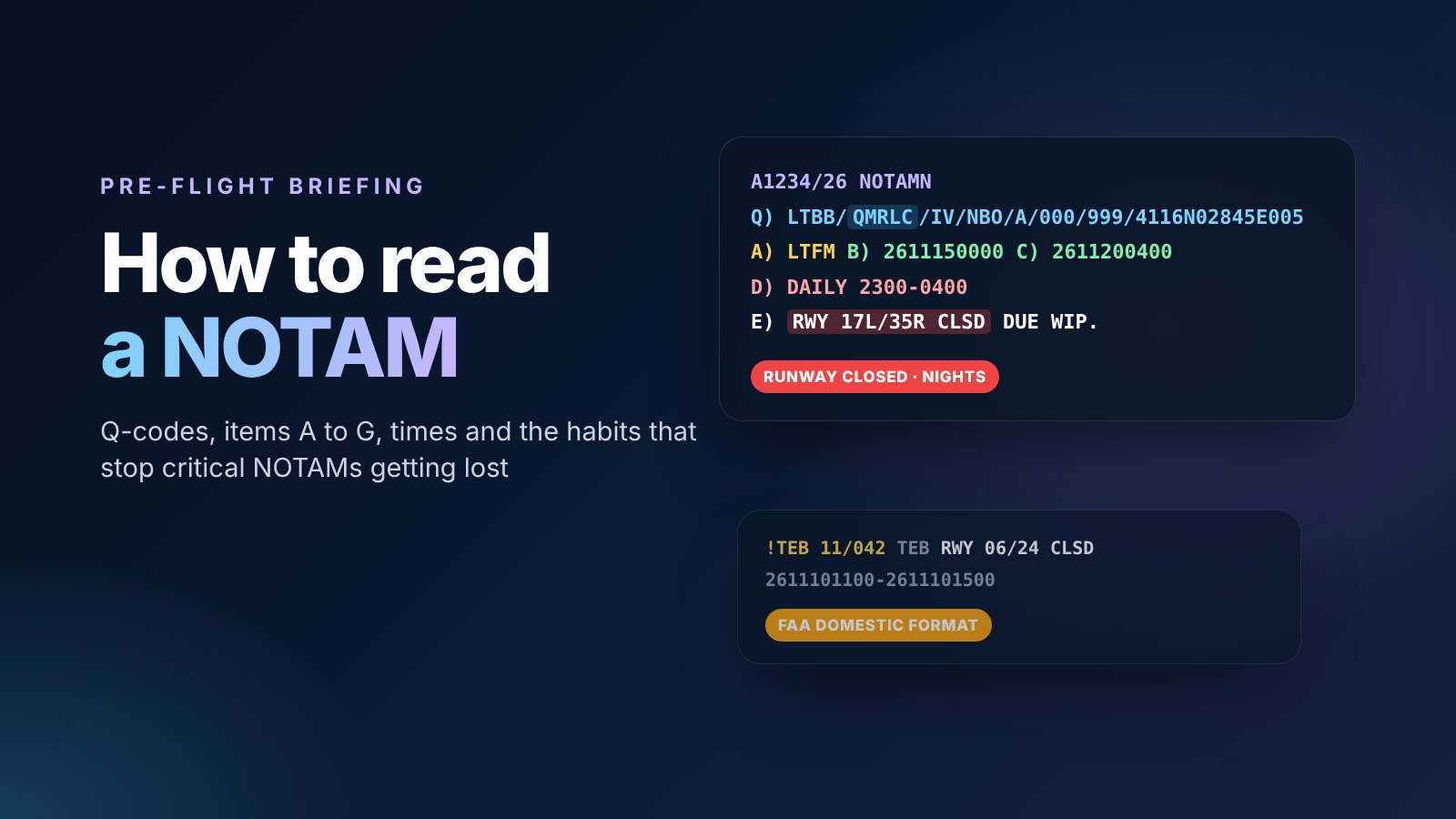
Knowing how to read a NOTAM is one of those skills every pilot and dispatcher learns early and then under-uses for years. A typical business jet briefing can contain dozens of NOTAMs across departure, destination, alternates and the flight information regions on the way. Most do not matter for your flight; a few matter enormously. This guide explains the ICAO NOTAM format item by item, decodes the Q-line and its five-letter codes, covers the US domestic format and the FAA's new NOTAM system, and then goes deeper into timing traps, triage and the incidents that show why it matters. A NOTAM decoder lets you paste real examples and check whether they apply at your flight time.
What is a NOTAM?
A NOTAM (Notice to Airmen) is a notice distributed by an aeronautical information service about a change to facilities, services, procedures or hazards that matters to flight operations and is temporary, short-notice or not yet in the published documents. The permanent information lives in the aeronautical information publication (AIP); NOTAMs carry what changes in between.
The International Civil Aviation Organization (ICAO) sets the standard format. In the United States, the Federal Aviation Administration (FAA) also uses a domestic format; it used the term "Notice to Air Missions" for a period from 2021 and has since returned to "Notice to Airmen". Either way, the job is the same: tell crews what is different today.
How to read a NOTAM in ICAO format
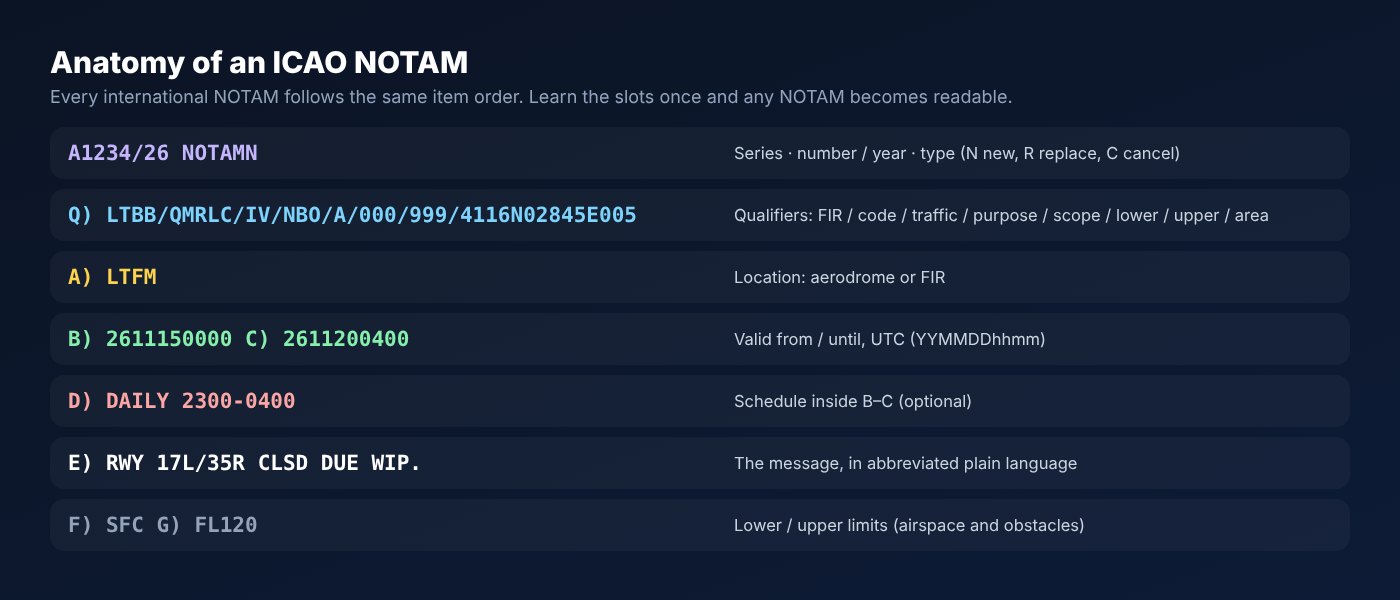
Every ICAO NOTAM uses the same fixed slots. Learn them once and any NOTAM in the world becomes readable. The FAA publishes a clear ICAO NOTAM format example for reference.
The header: series, number and type
A1234/26 NOTAMN means series A, number 1234 of 2026, a new NOTAM. States assign series letters to different subjects or areas. The last letter shows the type:
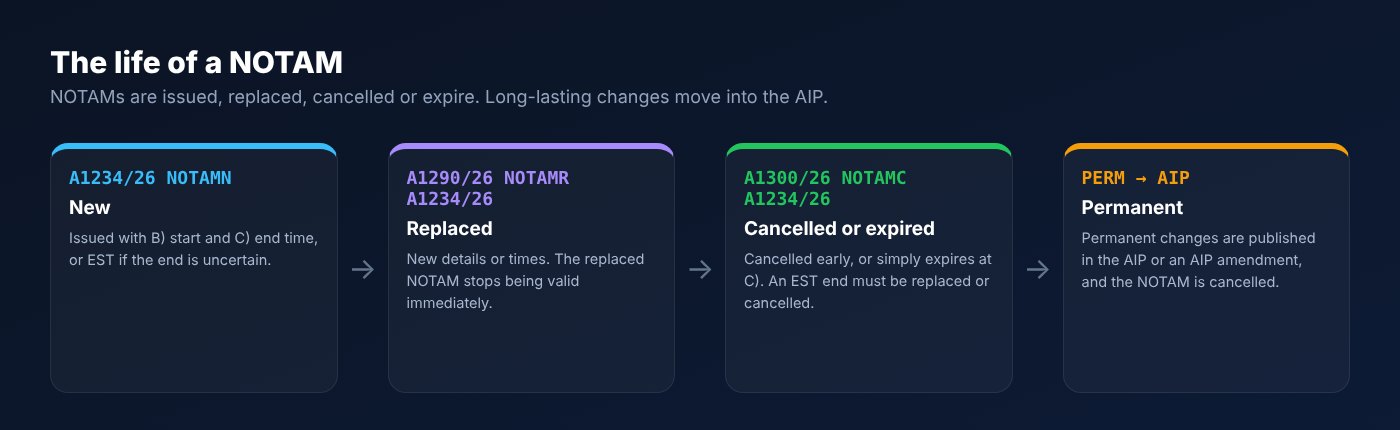
- NOTAMN: a new NOTAM.
- NOTAMR: replaces an earlier NOTAM, which is quoted after it, for example
NOTAMR A1234/26. The replaced NOTAM ceases to be valid when the new one takes effect. - NOTAMC: cancels an earlier NOTAM, again quoted after it.
Items A to G
| Item | Meaning | Detail that catches people out |
|---|---|---|
| A) | Location: ICAO indicator of the aerodrome or FIR | Can list several FIRs for one en-route NOTAM. |
| B) | Start of validity, UTC, YYMMDDhhmm | Always UTC. A night closure in local time may start on the previous UTC date. |
| C) | End of validity, UTC | "EST" means estimated: a NOTAMR or NOTAMC must follow. "PERM" means permanent until published in the AIP. |
| D) | Schedule within B–C | A NOTAM valid for five days may be active only at night. Check D before assuming it applies all day. |
| E) | The text | Uses ICAO abbreviations (CLSD, U/S, AVBL, WIP). Read the whole line: exceptions often hide at the end. |
| F) and G) | Lower and upper limits | Used for airspace and obstacles: SFC, feet AMSL or flight levels. |
Decoding the Q-line
The Q-line, or qualifier line, is the machine-readable summary of the NOTAM. Briefing systems use it to filter and sort, and once you can read it you can judge a NOTAM before reading its text. Take Q) LTBB/QMRLC/IV/NBO/A/000/999/4116N02845E005:
| Field | Example | Meaning |
|---|---|---|
| FIR | LTBB | Flight information region (FIR) where the subject is: Istanbul. |
| NOTAM code | QMRLC | Subject and condition: runway, closed. |
| Traffic | IV | Affects IFR (I) and VFR (V) traffic. |
| Purpose | NBO | N: immediate attention; B: pre-flight briefing; O: flight operations. M is miscellaneous and K is a checklist. |
| Scope | A | A: aerodrome; E: en-route; W: navigation warning; combinations such as AE are possible. |
| Lower / upper | 000/999 | Vertical limits in flight levels (hundreds of feet); 000 is the surface and 999 unlimited. |
| Coordinates and radius | 4116N02845E005 | Centre point in degrees and minutes, and radius of influence in nautical miles (NM). |
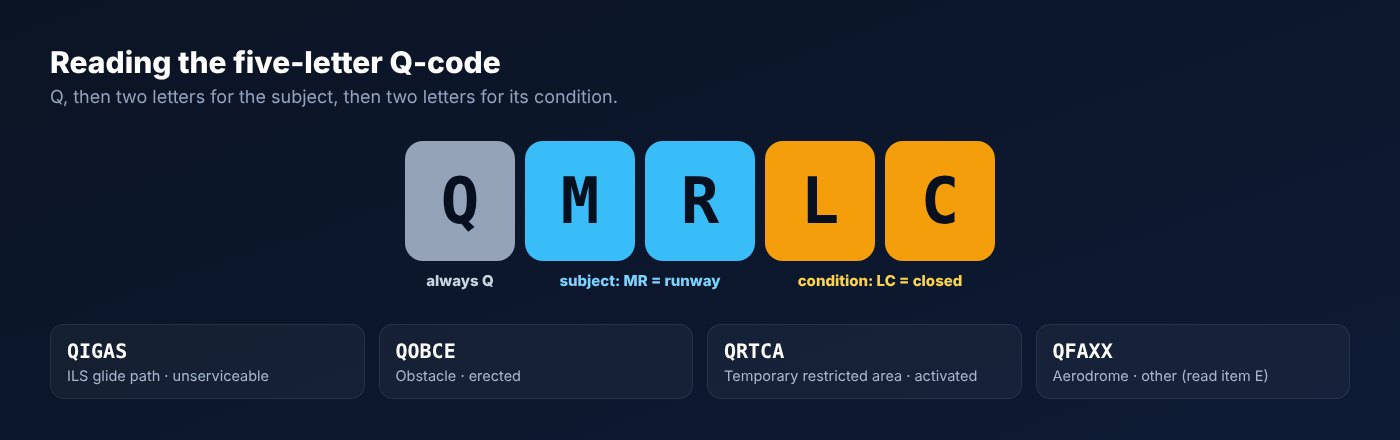
The second and third letters name the subject: MR runway, MX taxiway, MN apron, FA aerodrome, IC instrument landing system (ILS), IG ILS glide path, NV VOR, OB obstacle, RT temporary restricted area, WU unmanned aircraft. The fourth and fifth letters give the condition: LC closed, AS unserviceable, CA activated, CE erected, HW work in progress, LT limited to. The full list is maintained in ICAO Doc 8126 and reproduced in the FAA's Q-code reference.
A practical trick: the purpose letters tell you how the originator rated the NOTAM. "N" for immediate attention is rare and worth reading first. A scope of "W" on an en-route NOTAM usually means a navigation warning such as firing, drones or a parachute area along your route.
Decode a NOTAM yourself
Choose an example or paste a NOTAM from your own briefing, then set your flight time in UTC. The decoder splits the Q-line, explains every item, expands abbreviations in item E, draws the validity period and daily schedule on a timeline, and tells you whether the NOTAM is active at your time, outside its schedule, not yet active or expired. It reads ICAO and FAA domestic formats.
How to read a NOTAM in FAA domestic format
US domestic NOTAMs look different. A typical example: !TEB 11/042 TEB RWY 06/24 CLSD 2611101100-2611101500.
- !TEB: the accountability location, the facility responsible for the NOTAM.
- 11/042: the month and sequence number.
- TEB: the affected location.
- RWY: a keyword showing the category. Others include TWY, APRON, AD, NAV, COM, SVC, OBST, AIRSPACE, IAP and ODP.
- 06/24 CLSD: the condition, in abbreviated plain language.
- 2611101100-2611101500: start and end, UTC, in the same YYMMDDhhmm format.
The US also issues Flight Data Center (FDC) NOTAMs for regulatory items such as temporary flight restrictions and changes to instrument procedures, which are easy to miss if a briefing is filtered by aerodrome only.
The FAA's new NOTAM system
On 11 January 2023, a failure of the FAA's legacy NOTAM system led to a nationwide ground stop. The FAA's replacement, the NOTAM Management Service (NMS), began operations on 29 September 2025, according to the FAA announcement, and is planned to replace the US NOTAM System and the Federal NOTAM System during 2026. The FAA's NMS FAQ states that the agency will adopt the ICAO NOTAM format and replace the domestic format once the transition is complete, so crews flying in the US should expect the ICAO structure to become standard.
Timing traps: UTC, EST, PERM and schedules
- Everything is UTC. A runway closure "2300-0400" in item D starts the evening before in UTC terms. In Istanbul (UTC+3), that closure runs from 02:00 to 07:00 local time.
- EST is a promise to update. If an estimated end time passes without a replacement or cancellation, treat the NOTAM as still in force and check with the aeronautical information service or the airport.
- PERM is temporary paperwork for a permanent change. The information will move into the AIP, and the NOTAM will then be cancelled.
- Long-lasting NOTAMs are a warning sign. ICAO guidance is that temporary changes of three months or longer should be published as AIP supplements. A NOTAM that has been renewed for many months may be easy to overlook in a long briefing.
- Your time is a window, not a point. Check the whole period from departure to arrival plus the time you could hold or divert, especially for alternates.
Special NOTAM types
- SNOWTAM: reports runway surface conditions. Since November 2021 it uses the ICAO Global Reporting Format (GRF), with a runway condition code (RWYCC) from 6 (dry) to 0 for each third of the runway.
- ASHTAM: volcanic activity and ash clouds that affect operations.
- Trigger NOTAM: draws attention to an AIP amendment or supplement that becomes effective on an AIRAC date.
- Checklist NOTAM: issued regularly, usually monthly, listing the valid NOTAMs in a series so users can check their records are complete.
Why NOTAMs get missed
NOTAM overload is a recognised safety problem. On 7 July 2017, Air Canada Flight 759 aligned its night approach at San Francisco with a parallel taxiway instead of runway 28R, while four aircraft were waiting on that taxiway. The crew went around at very low height. The parallel runway 28L was closed, and the NOTAM was in the crew's briefing package. The NTSB report (AIR-18/01) found that the way flight operations information was presented made it difficult to identify the critical item, and it recommended improvements in how NOTAMs are organised and shown to crews.
The NOTAM was there. The problem was finding it among everything else.
The lesson for operators is that "we had it in the briefing" is not the same as "the crew noticed it". Briefing design, filtering and a short list of critical items matter as much as the NOTAMs themselves.
How to triage a NOTAM briefing
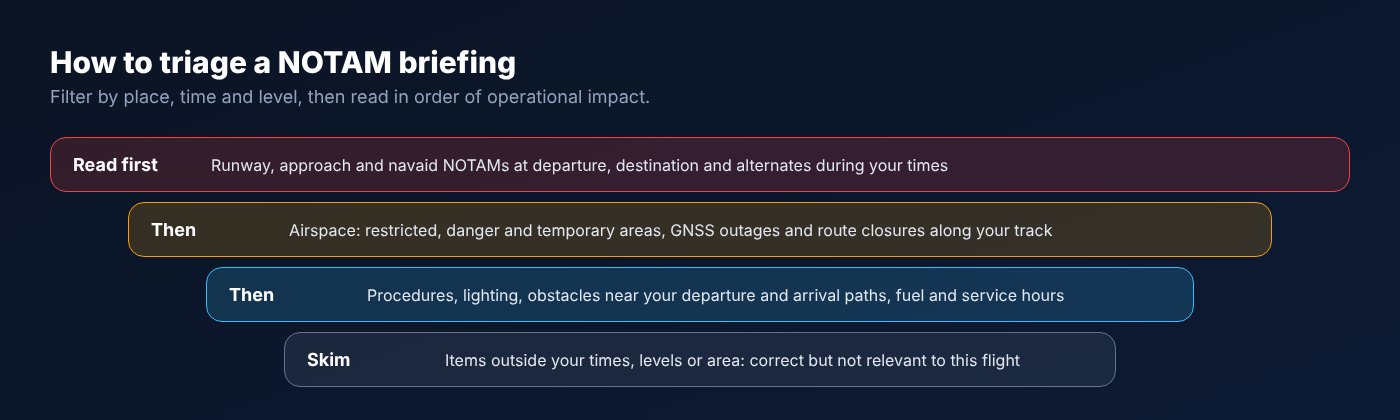
- Filter by place. Departure, destination, take-off and destination alternates, and every FIR along the route.
- Filter by time. From off-blocks to the latest possible landing at an alternate, including holding and diversion time.
- Filter by level. Use the Q-line lower and upper limits to drop airspace NOTAMs far above or below your profile.
- Read the critical categories first: runways, approaches, navaids and lighting at the airports you will use.
- Write down what changes the plan. A one-line list, such as "LTFM 17L/35R closed nights; EGLL 27L LOC only", is what the crew will remember on the approach.
- Re-check before departure. NOTAMs are issued around the clock; a briefing pulled at 06:00 can be out of date by 09:00.
NOTAMs work alongside weather. For the forecast side of alternate selection, see our guides on how to read a TAF and how to read a METAR.
Common NOTAM abbreviations
| Abbreviation | Meaning | Abbreviation | Meaning |
|---|---|---|---|
| CLSD | Closed | U/S | Unserviceable |
| AVBL | Available | WIP | Work in progress |
| ACT | Active | PPR | Prior permission required |
| THR / DTHR | Threshold / displaced threshold | TORA / LDA | Take-off run / landing distance available |
| GP / LOC | Glide path / localizer | OBST | Obstacle |
| AMSL / AGL | Above mean sea level / above ground level | SFC / UNL | Surface / unlimited |
| BTN / EXC | Between / except | HJ / HN | Sunrise to sunset / sunset to sunrise |
Common mistakes: reading B and C but ignoring the D schedule; converting UTC to local time wrongly around midnight; treating an expired EST end time as the end of the NOTAM; filtering by aerodrome only and missing FDC or en-route NOTAMs; forgetting alternates; reading the Q-code but not the full E text; and briefing hours before departure without a final update.
Key takeaways
- An ICAO NOTAM has a header, a Q-line and items A to G, always in the same order.
- The five-letter Q-code gives the subject and condition; XX means read item E.
- All times are UTC; D can limit a NOTAM to certain hours inside B–C; EST and PERM need special care.
- The FAA's new NOTAM system began operating in September 2025, and the US plans to adopt the ICAO format.
- Filter by place, time and level, read runway and approach NOTAMs first, and write down what changes the plan.
Keep every trip's briefing in one place
NOTAM filtering starts with knowing exactly which airports and time windows each trip involves. Aero Sync Flight Operations keeps every trip's route, times, aircraft and crew in one schedule, so dispatchers and crews brief from the same plan.
Frequently asked questions
What does NOTAM stand for?
Notice to Airmen. The FAA used "Notice to Air Missions" for a period from 2021 and has since returned to "Notice to Airmen". ICAO uses the term NOTAM.
How do you read a NOTAM?
Read the header for the number and type, the Q-line for the FIR, subject, condition and area, item A for the location, items B and C for UTC validity, item D for any schedule, and item E for the full text. Then check whether your flight time falls inside it.
What is the Q-line in a NOTAM?
The qualifier line: FIR, five-letter NOTAM code, traffic, purpose, scope, lower and upper limits, and the coordinates and radius of the affected area. Briefing systems use it to filter NOTAMs.
What does QMRLC mean?
Q is fixed, MR means runway and LC means closed: a runway closure. Item E gives the runway and the reason.
Are NOTAM times in UTC or local time?
UTC. Times are written as YYMMDDhhmm, for example 2611150000 is 15 November 2026 at 00:00 UTC.
What does EST mean in a NOTAM?
The end time in item C is estimated. The issuing office must replace or cancel the NOTAM; until it does, treat the NOTAM as still in force.
What does PERM mean in a NOTAM?
The change is permanent. It will be published in the AIP, after which the NOTAM is cancelled.
What is the difference between NOTAMN, NOTAMR and NOTAMC?
NOTAMN is a new NOTAM, NOTAMR replaces an earlier NOTAM, and NOTAMC cancels one. The replaced or cancelled NOTAM number follows the type.
What is item D in a NOTAM?
A schedule that limits when the NOTAM is active within the B–C period, such as DAILY 2300-0400 or MON-FRI 0700-1700, in UTC.
What is an FDC NOTAM?
In the US, a Flight Data Center NOTAM covers regulatory items such as temporary flight restrictions and changes to instrument approach procedures and charts.
What is a SNOWTAM?
A special series NOTAM reporting runway surface conditions. Since November 2021 it uses ICAO's Global Reporting Format with runway condition codes from 6 to 0.
Is the FAA changing NOTAMs?
Yes. The FAA's NOTAM Management Service began operating in September 2025 to replace the legacy systems, and the FAA has said it will adopt the ICAO NOTAM format after the transition.
How long can a NOTAM be valid?
There is no hard limit in the format, but ICAO guidance is that temporary changes of three months or longer should be published as AIP supplements rather than NOTAMs.
How can I avoid missing important NOTAMs?
Filter by airports, route, time window and levels, read runway, approach and navaid NOTAMs first, write a short list of items that change your plan, and update the briefing just before departure.