 Aero Sync


Brochures make every business jet look perfect. Each one has the longest range, the quietest cabin or the lowest cost in its class. Knowing how to compare business jets fairly is what separates a good purchase from an expensive mistake. This guide gives buyers, brokers and flight departments a clear method: start with the mission, test range against real conditions, measure the cabin, check the runways, then compare cost per trip.
Rule number one: compare jets against your missions, not against each other. A jet that wins every column on a spec sheet can still be the wrong aircraft for the trips you actually fly.
What should you define before comparing business jets?
Write down your mission profile before you open a single brochure. It turns a confusing spec sheet into a simple pass or fail test. Experienced brokers start here when they work out how to compare business jets for a client, because it removes most aircraft from the list in minutes.
| Question | Why it matters |
|---|---|
| What is your typical trip? | Choose the jet for the 80% of trips you fly most, not the rare long one. |
| What is your longest regular trip? | Sets the minimum real-world range you need without a fuel stop. |
| How many passengers, typically and at most? | Range falls as payload rises. Four people and nine people are different missions. |
| Which airports do you use? | Short, high or hot runways can rule a jet out completely. |
| What do you carry? | Skis, golf bags, pets and long-trip luggage need real baggage space. |
| How many hours a year will you fly? | Affects whether running costs or purchase price matter more. |
| Where will the jet be based and maintained? | A strong local service network saves time and money. |
Many buyers also list "nice to have" items, such as a flat-floor cabin, a full galley or fast connectivity. Keep them separate from the "must haves" so they do not distort the comparison.
How do you compare business jet range?
Range is the number buyers look at first, and the one most often misunderstood. A published range is measured under specific conditions that rarely match a real trip.
What is behind a published range figure?
Manufacturers usually quote range with a set number of passengers, at long-range cruise speed, in still air and with NBAA IFR reserves. Those reserves are enough fuel to fly to an alternate airport about 200 nm away and hold for 30 minutes. Always check how many passengers the figure assumes. A range quoted with four passengers can drop noticeably with eight on board.
Why is real-world range shorter?
- Winds: strong winter headwinds on westbound routes, such as Europe to the US, can cut effective range by hundreds of miles.
- Payload: every extra passenger and bag reduces the fuel you can carry.
- Speed: flying at maximum cruise instead of long-range cruise burns more fuel.
- Weather and alternates: a distant alternate airport needs more reserve fuel.
- Hot airports: high temperatures can limit take-off weight, and therefore fuel.
A practical approach is to compare published range with your route distance plus a margin. Many planners use about 10% for typical conditions and 15–20% for westbound winter flights or full cabins. Try it with the checker below.
| Route (great-circle) | Distance | Range needed (+10%) |
|---|---|---|
| Istanbul → London Farnborough | 1,352 nm | 1,487 nm |
| Teterboro → Aspen | 1,502 nm | 1,652 nm |
| Riyadh → London Farnborough | 2,675 nm | 2,943 nm |
| Dubai → London Farnborough | 2,978 nm | 3,276 nm |
| Teterboro → London Farnborough | 2,986 nm | 3,285 nm |
| Geneva → Teterboro | 3,352 nm | 3,687 nm |
| Dubai → Johannesburg | 3,463 nm | 3,809 nm |
| Los Angeles (Van Nuys) → London Farnborough | 4,718 nm | 5,190 nm |
What is full-fuel payload?
Full-fuel payload is the weight of people and bags you can carry with the tanks full. It is one of the most useful numbers for comparing jets. A jet with a low full-fuel payload forces you to choose between passengers and range on long trips. A high one lets you fill the seats and still fly the full distance.
How do you compare business jet cabins?
You will spend every flight hour inside the cabin, so compare it carefully. Numbers help, but nothing replaces sitting in the actual aircraft on a long demo flight.
- Height: at around 6 feet (1.83 m) most adults can stand upright. Below that, people stoop to move around.
- Width: width decides how comfortable the seats are and how wide the aisle feels. A few inches make a big difference.
- Length and zones: longer cabins can be split into separate areas for meetings, dining and rest.
- Cabin volume: a useful single number, but check whether it includes the lavatory and baggage area.
- Floor: a flat floor without a dropped aisle makes the cabin feel larger and is easier to walk on.
What is cabin altitude and why does it matter?
Cabin altitude is the "altitude" passengers feel inside the pressurised cabin. Rules allow up to 8,000 feet, but many modern jets keep it far lower at cruise. A lower cabin altitude means more oxygen, less fatigue and fewer headaches on long flights. For long-range missions, it is worth comparing.
Baggage, lavatory and comfort details
Check whether the baggage hold can be reached in flight, how big the door is and whether it is heated. Compare the lavatory, the galley, seat count in your preferred layout, noise levels, window size and connectivity. These details shape how passengers feel about the jet far more than a few knots of speed.
How do you compare runway performance?
Runway performance decides which airports you can use, which is often the deciding factor for owners who fly to ski resorts, islands or city airports.
Take-off distance
Published take-off distance is usually measured at maximum weight, at sea level, on a standard 15 °C day and a dry runway. Real airports are often higher, hotter or wetter. At a high-altitude airport like Aspen, where the 8,006 ft runway sits at about 7,820 ft elevation, thin air can cut the weight you can lift on a warm day. That means fewer passengers or less fuel.
Landing distance
Landing distance matters most at short runways. Commercial and charter operations must also add safety margins to the published figure, so the runway you need in practice is much longer than the brochure number. If you may ever put the jet on a charter certificate, compare factored landing distances, not the basic figure.
Special approaches
Some airports need special certification. London City, for example, has a short runway of about 4,950 ft and a steep 5.5° approach, which only approved aircraft and crews can fly. If you use airports like this, check approval before anything else.
Tip: list your five most important airports and ask each manufacturer or seller for performance at those airports on a hot summer day. It is the fastest way to see which jets really fit.
Does cruise speed really matter?
Speed differences between jets in the same class are often smaller than they look. On a 1,000 nm trip, flying at 470 knots instead of 440 knots saves about 9 minutes. On a 2,000 nm trip, it saves about 17 minutes.
Speed matters more for very long trips, for crews close to their duty limits and for owners who value every minute. For most shorter missions, cabin, range and runway performance deserve more weight.
How should you compare business jet costs?
Comparing hourly operating costs is a good start, but it can mislead. The better question is what each jet costs for your trips and over your ownership period.
- Cost per trip: a faster jet with a higher hourly cost may cost about the same per trip. Jet A at $3,800 an hour and 440 knots costs about $17,300 for 2,000 nm. Jet B at $4,200 an hour and 470 knots costs about $17,900.
- Value retention: a jet that loses less value can be cheaper overall even if it costs more to buy.
- Maintenance events: check when the next major inspection is due on a pre-owned jet. A large event soon after purchase changes the price you should pay.
- Programmes: engine and airframe programmes affect both cost and resale value.
For a full breakdown of fixed and variable costs, read our guide to the cost of owning a private jet. Deciding how to pay for it? See lease vs buy for private jets.
Example: how to compare business jets in the super-midsize class
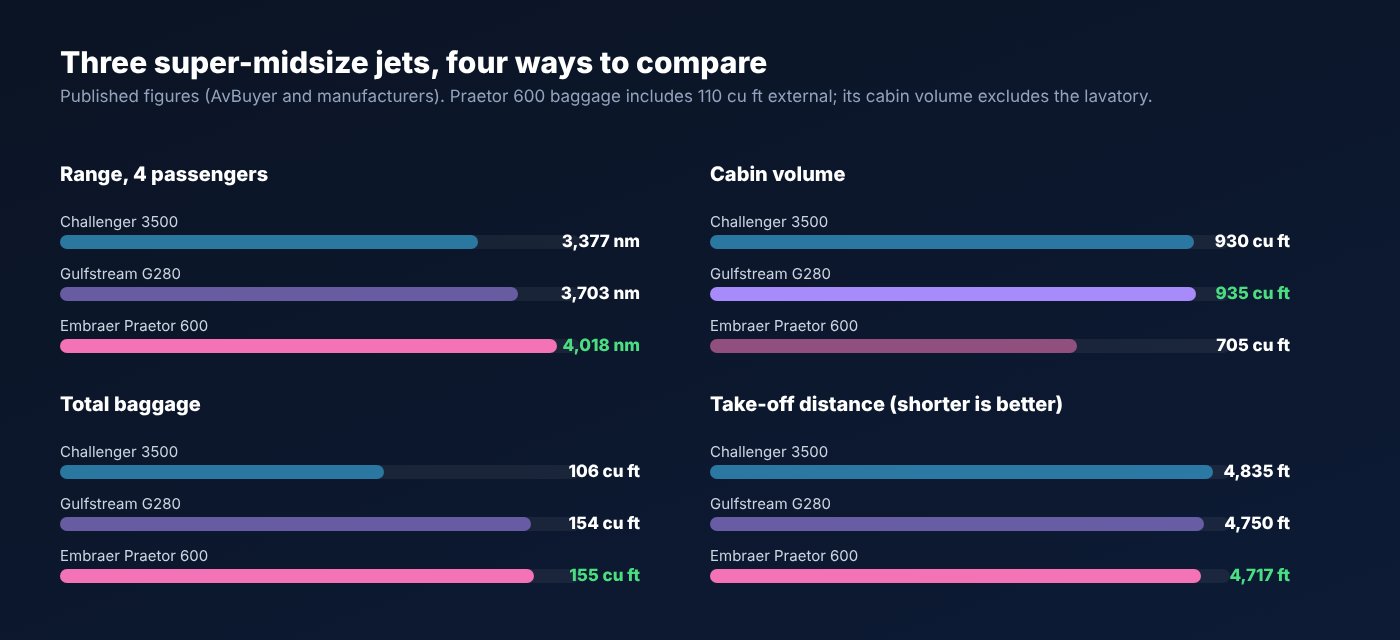
Here is how the method works on three popular super-midsize jets. The figures come from published comparisons by AvBuyer and manufacturer data. Always check the latest official documents before you decide.
| Specification | Challenger 3500 | Gulfstream G280 | Embraer Praetor 600 |
|---|---|---|---|
| Range, 4 passengers | 3,377 nm | 3,703 nm | 4,018 nm |
| Cabin volume | 930 cu ft | 935 cu ft | 705 cu ft (excl. lavatory) |
| Cabin width | 7.2 ft | Similar, slightly narrower | 6.8 ft |
| Baggage | 106 cu ft, internal | 154 cu ft | 45 cu ft internal + 110 cu ft external |
| Take-off distance | 4,835 ft | 4,750 ft | 4,717 ft |
| Landing distance | 2,364 ft | 2,365 ft | 2,165 ft |
The Praetor 600 has the longest range. The Challenger 3500 has the widest cabin. The G280 combines strong range with the largest internal baggage area. None of them wins everything, which is exactly why a scoring method helps. Sources for the Praetor 600 comparison: AvBuyer.
How do you score business jets fairly?
Brokers and flight departments often use a weighted scoring matrix. Give each criterion a weight that reflects your mission, score each jet from 1 to 5, then multiply. Set the weights before you look at the scores, so your favourite jet cannot win by accident.
| Criterion (weight) | Challenger 3500 | Gulfstream G280 | Embraer Praetor 600 |
|---|---|---|---|
| Range (30%) | 3 | 4 | 5 |
| Cabin (30%) | 5 | 5 | 3 |
| Runway performance (20%) | 3 | 4 | 4 |
| Baggage (20%) | 3 | 5 | 4 |
| Weighted score | 3.6 | 4.5 | 4.0 |
Now change the weights for a buyer who mostly flies long trips: range 60%, cabin 20%, runway 10%, baggage 10%. The scores become 3.4, 4.3 and 4.4, and the Praetor 600 moves to the top. The aircraft did not change. The mission did. That is the whole point of comparing jets this way.
The best business jet is not the one with the best numbers. It is the one whose numbers match your missions.
What else should be on your comparison list?
- Service network: how close the nearest authorised service centre is to your base and your main destinations.
- Production status: aircraft still in production usually have better parts supply and stronger resale values.
- Avionics and upgrades: check whether the jet meets current and upcoming equipment rules in the regions you fly.
- Crew requirements: some light jets can be certified for a single pilot, which changes crew costs.
- Maintenance history: for pre-owned jets, complete records, programme status and damage history all affect value.
- Interior age: an older interior may need a refurbishment soon after purchase.
How to compare business jets in 7 steps
- Write your mission profile: typical and longest trips, passengers, airports and baggage.
- Remove every jet that cannot fly your longest regular trip with a sensible margin.
- Remove every jet that cannot use your key airports in summer conditions.
- Compare cabins of the remaining jets, ideally on demo flights.
- Set your weights and score each jet in a matrix.
- Compare cost per trip, value retention and upcoming maintenance.
- Take the top two or three jets into detailed offers and pre-purchase inspections.
Common mistakes: buying for the one long trip you take each year, trusting still-air range on winter westbound routes, ignoring hot-day performance at your favourite airport, and comparing hourly costs without looking at speed and value retention.
Key takeaways
- The right way to compare business jets starts with your mission profile.
- Published range assumes still air and a light load, so add a margin.
- Check cabin height, width, baggage access and cabin altitude, not just seat count.
- Test runway performance at your own airports on a hot day.
- Compare cost per trip and value retention, not only cost per hour.
- Use a weighted score, and set the weights before you look at the results.
Compare business jets with Aero Sync
Doing this by hand takes hours of spreadsheets. The Aero Sync Business Jet Dashboard puts range, cabin, runway, speed and cost data for today's business jets on one screen. You can filter by size, rank aircraft by any figure and compare them side by side.
When you have a shortlist, the Trip Cost & Range Planner checks each jet against your real routes. The Depreciation Calculator then shows how each one is likely to hold its value.
Frequently asked questions
What is the most important factor when comparing business jets?
Your mission. Start with your typical and longest trips, number of passengers and key airports. Range, cabin and runway performance only matter in relation to those missions.
How accurate is a business jet's published range?
Published range is accurate for the conditions it assumes: a set number of passengers, long-range cruise speed, still air and NBAA IFR reserves. Real trips with headwinds, more passengers or higher speed have shorter range, so add a margin of about 10–20%.
What does NBAA IFR reserves mean?
It is a standard fuel reserve used in range figures. It includes enough fuel to fly to an alternate airport about 200 nm away and hold for 30 minutes after arriving at the destination.
What are the main business jet size categories?
Light jets usually seat 4–8 passengers and fly about 1,500–2,200 nm. Midsize jets seat 7–9 and fly about 2,000–3,000 nm. Super-midsize jets seat 8–10 and fly about 3,000–4,000 nm. Large-cabin and ultra-long-range jets seat 10–19 and fly from about 4,000 nm to more than 7,000 nm.
Can you stand up in a business jet cabin?
In most super-midsize and larger jets, yes. Cabins around 6 feet (1.83 m) tall let most adults stand. Many light jets and some midsize jets have lower cabins, so passengers stoop when moving.
What runway length does a business jet need?
Many business jets publish take-off distances between about 3,000 and 6,000 ft at maximum weight on a standard day. Hot weather, high airports, wet runways and charter safety margins increase the length you need in practice.
What is full-fuel payload?
Full-fuel payload is the weight of passengers and baggage a jet can carry with full fuel tanks. A higher full-fuel payload means you can fill more seats without giving up range.
What is cabin altitude?
Cabin altitude is the equivalent altitude passengers feel inside the pressurised cabin. Rules allow up to 8,000 ft, but many modern jets stay much lower, which reduces fatigue on long flights.
Should you compare new and pre-owned business jets together?
Yes, but compare them fairly. A pre-owned jet costs less to buy but may have upcoming inspections, an older interior or older avionics. Include those costs and the different value retention when you compare.
How many jets should be on a shortlist?
Most buyers and brokers narrow the field to two or three aircraft types before making offers. That is enough to keep sellers competitive without spreading inspections and demo flights too thin.
How do brokers compare business jets?
Brokers usually start with the client's mission, filter out jets that cannot fly it, then compare cabin, performance, cost and market availability. Many use a weighted scoring matrix and check maintenance status and value trends for each candidate.