 Aero Sync

A density altitude calculator answers a simple question with serious consequences: how high does the aircraft "think" it is today? On a hot afternoon at a mountain airport, an aircraft parked at 7,800 ft can perform as if it were above 11,000 ft. Take-off runs get longer, climb gradients shrink and true airspeeds rise. This guide explains density altitude from first principles, shows the exact formula with humidity, and then goes deeper into what matters for business jet crews: flat-rated engines, weight-altitude-temperature limits, climb gradients, tire speeds and landing distance. An interactive calculator lets you test your own airport.
Scope: performance figures in this article and calculator use simplified models to show trends. Take-off and landing planning must always use the aircraft flight manual (AFM) or approved performance software.
What is density altitude?
Density altitude (DA) is the altitude in the International Standard Atmosphere (ISA) at which the air would have the same density as the air around you now. The ISA is a reference atmosphere: 15 °C and 1013.25 hPa (29.92 inHg) at sea level, with temperature falling about 1.98 °C per 1,000 ft up to the tropopause.
Wings, propellers and engines all respond to air density, not to the height on the chart. Less dense air means less lift at a given true airspeed, less thrust or power from the engine, and less drag. So density altitude is the best single number for "how will the aircraft perform today?" The FAA Pilot's Handbook of Aeronautical Knowledge, chapter 11 covers the basics clearly; the rest of this guide builds on them.
Three steps lead from the runway to density altitude:
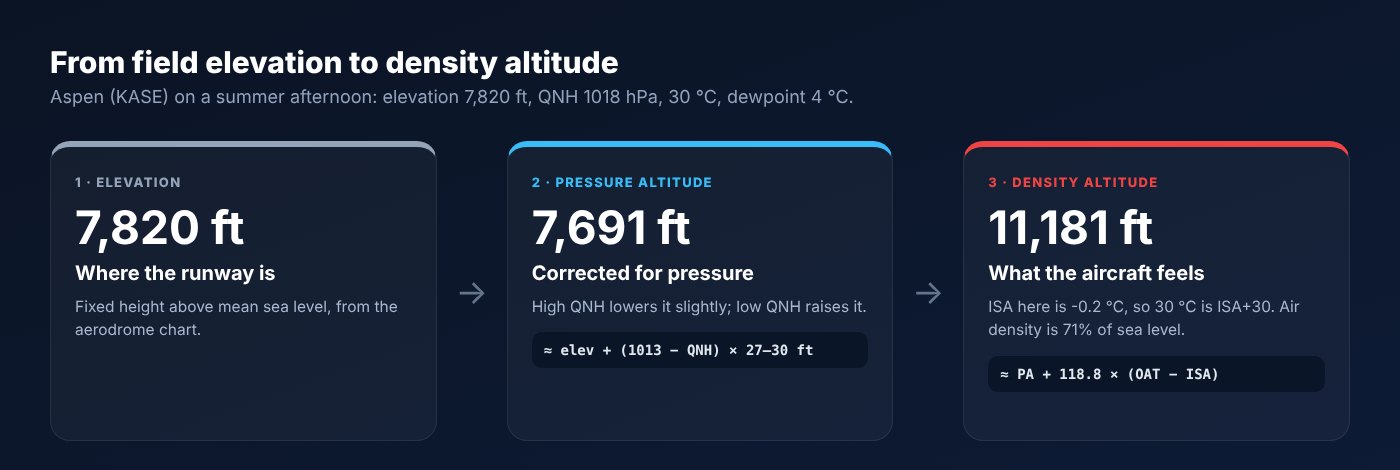
- Field elevation: the published height of the runway above mean sea level.
- Pressure altitude (PA): elevation corrected for the actual pressure, the altitude shown with 1013 hPa or 29.92 inHg set on the altimeter.
- Density altitude: pressure altitude corrected for non-standard temperature, and ideally for humidity.
How do you calculate density altitude?
Step 1: pressure altitude
The quick method: PA ≈ elevation + (1013 − QNH) × 27 ft in hPa, or elevation + (29.92 − altimeter) × 1,000 ft in inHg. Many pilots use 30 ft per hPa for simplicity; the true value is about 27 ft per hPa near sea level and grows with altitude. The exact relation is:
PA = elevation + 145,366 × (1 − (QNH ÷ 1013.25)^0.190284)
Step 2: ISA temperature and deviation
ISA temperature at the pressure altitude is 15 − 1.98 × PA ÷ 1,000 °C. The ISA deviation is the actual outside air temperature (OAT) minus that value. At 7,700 ft, ISA is about 0 °C, so 30 °C is ISA+30.
Step 3: density altitude
The rule of thumb is DA ≈ PA + 118.8 × (OAT − ISA), often rounded to 120 ft per °C. It is accurate to within a few hundred feet in dry air. The exact method computes air density from station pressure and temperature, then finds the ISA altitude with the same density. The US National Weather Service publishes the full method, including humidity, in its density altitude formula sheet:
- Vapour pressure from dewpoint:
e = 6.11 × 10^(7.5 Td ÷ (237.3 + Td))hPa. - Virtual temperature:
Tv = T ÷ (1 − (e ÷ p) × (1 − 0.622)), in kelvin, where p is station pressure. - Density altitude from the density ratio σ (sigma, actual density divided by sea-level ISA density):
DA = 145,442 × (1 − σ^0.235)ft.
The calculator below uses these exact equations, and shows the rule-of-thumb result next to them so you can see the difference.
Why temperature matters more than you think
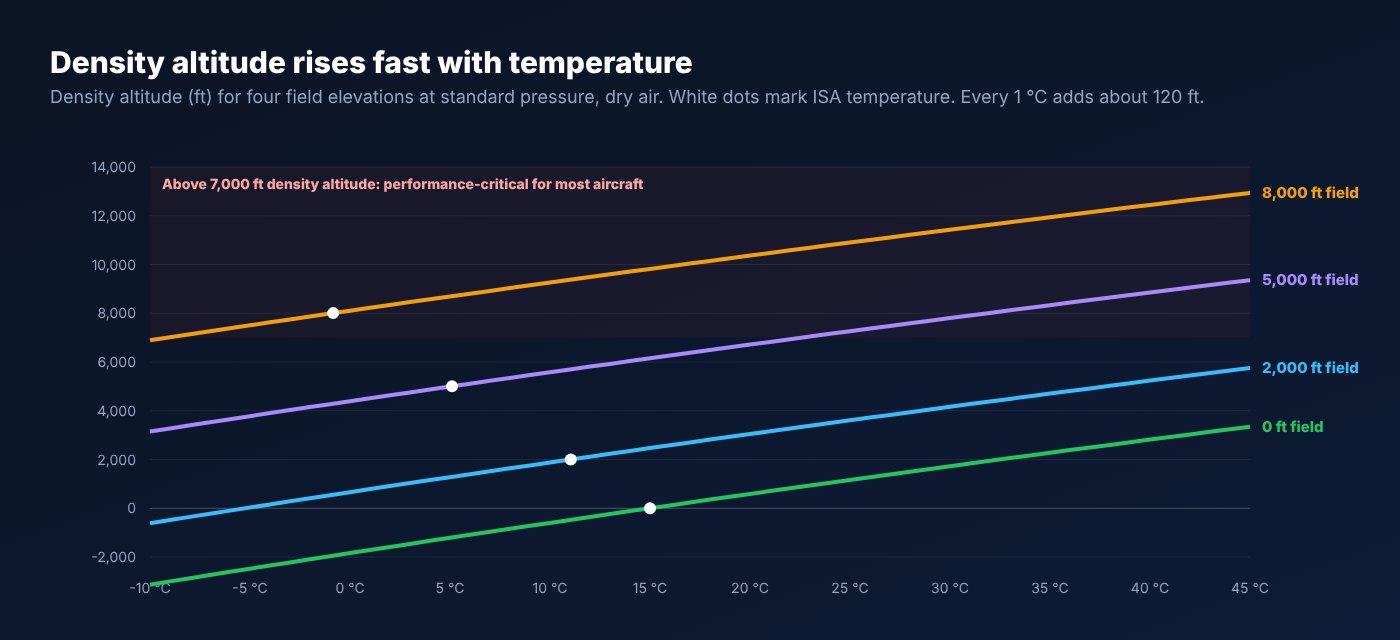
Every degree above ISA adds about 120 ft of density altitude. A 20 °C swing between a cool morning and a hot afternoon therefore moves density altitude by about 2,400 ft at the same airport, on the same day.
Humidity: small number, real effect
Water vapour is lighter than the nitrogen and oxygen it replaces, so humid air is less dense. On a hot, humid day at sea level the effect can add 400–500 ft of density altitude, which the dry rule of thumb misses. The FAA's density altitude safety pamphlet notes that humidity mostly affects engine power, and recommends adding 10% to computed take-off distance when humidity is high, for aircraft whose charts do not include it.
Try the density altitude calculator
Choose an airport preset or enter your own elevation, altimeter setting, temperature and dewpoint. The gauge shows density altitude, the cards show pressure altitude, ISA deviation, air density, the true airspeed increase and the humidity effect, and the runway graphic estimates how much longer the take-off becomes for a jet, turboprop or piston aircraft.
How density altitude affects aircraft performance
Higher true airspeed for the same indicated speed
The wing needs the same indicated airspeed (IAS) to lift off whatever the density, because IAS reflects dynamic pressure. In thin air, that same IAS means a higher true airspeed (TAS): roughly TAS = IAS ÷ √σ. At a density altitude of 10,000 ft, σ is about 0.74, so TAS is about 16% higher. With no wind, groundspeed at lift-off is 16% higher too.
Because the distance needed to accelerate grows with the square of the speed, a 16% higher lift-off groundspeed alone adds about 35% to the ground roll, before any loss of thrust is counted.
Less power or thrust
- Normally aspirated piston engines lose power roughly in proportion to density. A common approximation, the Gagg-Ferrar relation, gives power ratio ≈ 1.132σ − 0.132, so at σ = 0.74 the engine makes about 70% of sea-level power.
- Turbocharged pistons hold sea-level manifold pressure up to their critical altitude, then lose power like a normally aspirated engine.
- Turbine engines lose thrust with lower pressure and higher temperature, but most business jet engines are flat-rated, which changes the picture.
Longer take-off and landing, weaker climb
Combine higher speeds with less thrust and the effect compounds. The FAA's Koch chart example shows how severe it can be for a light piston aircraft: at 6,000 ft and 38 °C, take-off distance increases by about 230% and climb rate falls by about 76% compared with sea level standard. Jets suffer less, but their margins are also thinner because their certification standards demand more.
Flat rating: why jets cope until it gets hot
A flat-rated engine is limited by its control system to a fixed take-off thrust up to a certain temperature, often around ISA+15 °C or higher, even though it could produce more in cold air. This protects the engine's turbine temperature and gives consistent performance across a wide range of conditions.
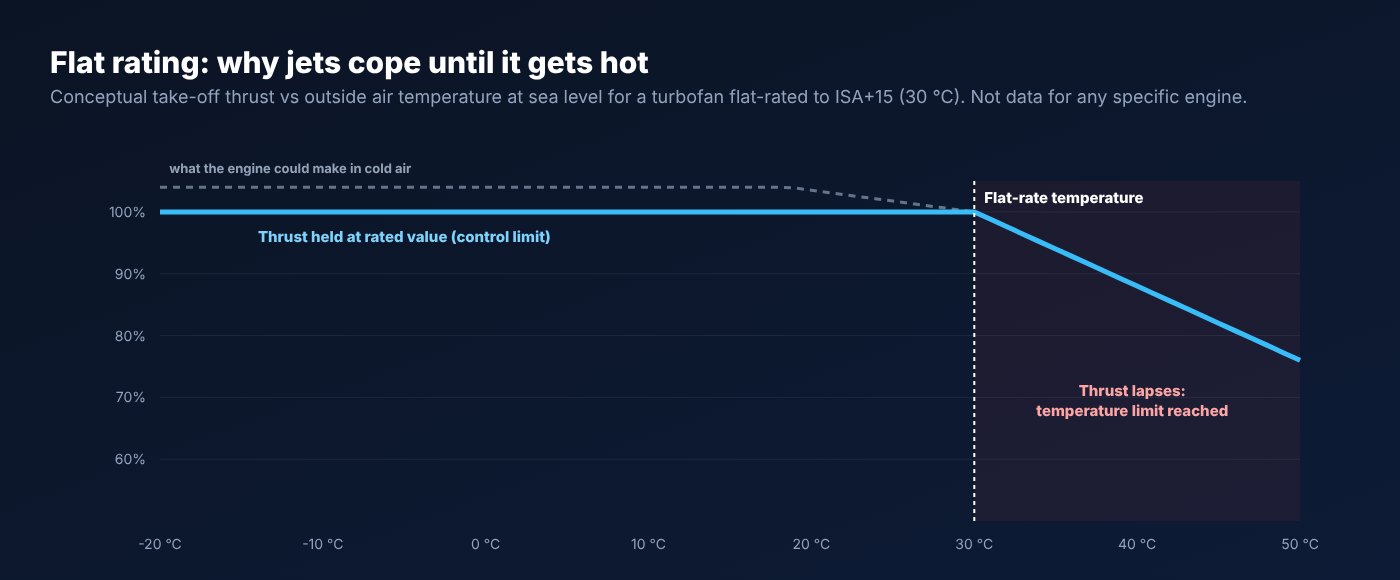
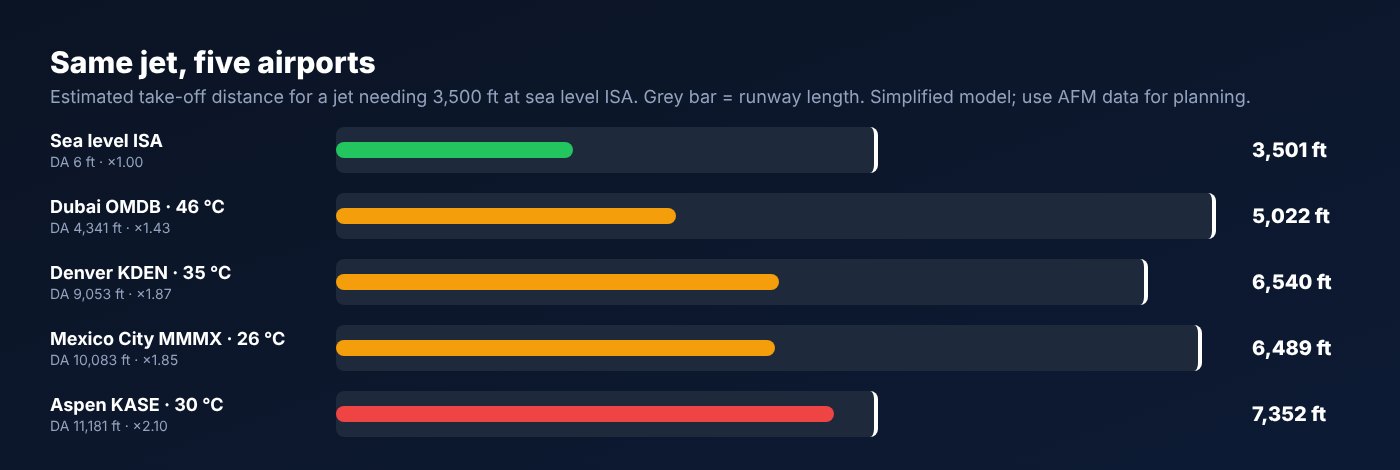
For crews, this creates a threshold effect. On a mild day at altitude, a jet loses relatively little thrust. Once OAT passes the flat-rate temperature for that pressure altitude, thrust starts falling with every degree, at exactly the moment the higher density altitude is also demanding a longer, faster take-off run. Hot-and-high airports in summer combine both penalties.
What limits a jet's take-off weight at high density altitude?
Runway length is only one of several limits. Any of these can set the maximum take-off weight on a hot, high day:
- Field length: the take-off distance, accelerate-stop distance and, for transport category aircraft, the balanced field length with an engine failure at V1 (the take-off decision speed).
- Climb gradient (WAT limit): the weight-altitude-temperature limit ensures the aircraft can climb with one engine inoperative. For transport category twin-engine aircraft, 14 CFR 25.121 requires a second-segment gradient of at least 2.4%. Thin, hot air reduces the gradient available.
- Obstacle clearance: the net flight path must clear obstacles by the required margin. Mountain airports often have departure procedures with climb gradients well above the certification minimum.
- Tire speed: higher TAS means higher groundspeed at lift-off. On a hot, high day with a tailwind, the tire speed limit can be reached before the runway or climb limit.
- Brake energy: a rejected take-off from a higher groundspeed puts much more energy into the brakes, which can limit V1 and therefore weight.
At hot and high airports, the question is rarely "is the runway long enough?" It is "which of five limits bites first?"
Landing at high density altitude
Approach speeds are flown as IAS, so TAS and groundspeed on final are higher at high density altitude. The landing roll is longer, brake energy is higher and go-around performance is reduced. Commercial operators also apply landing distance factors: under 14 CFR 135.385, a large transport category turbine aeroplane must be planned to land within 60% of the effective runway length at the destination, which leaves little room at a short mountain strip on a hot afternoon. For the wind side of the landing calculation, see our guide on how to calculate crosswind.
How to operate safely at high density altitude
- Calculate it every time. Use current METAR temperature, dewpoint and altimeter setting, not yesterday's numbers.
- Use the AFM or performance software. Rules of thumb show trends; certified data sets limits.
- Fly early or late. Morning departures can be thousands of feet lower in density altitude than mid-afternoon.
- Reduce weight. Fewer passengers, less baggage, or less fuel with a planned fuel stop at a lower, cooler airport.
- Check the climb, not only the runway. Confirm one-engine-inoperative climb and the departure procedure gradient.
- Use the right configuration. Bleed air off, the AFM-recommended flap setting and improved-climb procedures where approved.
- Brief the abort. On a long, hot take-off roll, everyone should know the V1 call and the plan if something fails.
How to use a density altitude calculator in flight planning
A density altitude calculator is most useful when it is part of a routine, not a one-off check on a hot day. Good practice for dispatchers and crews:
- Run it for the planned departure time, not now. Use the TAF or forecast temperature for the hour of departure. A morning density altitude calculator result can be 2,000 ft lower than the afternoon value.
- Run it for the destination and alternate too. Landing distance and go-around climb depend on density altitude at the arrival airport.
- Compare with the AFM threshold. Many operators set a trigger, such as density altitude above 5,000 ft or ISA+20, at which a full performance calculation and a second-person check become mandatory.
- Record the result. Writing density altitude on the trip sheet makes it part of the briefing and gives the team data to spot recurring weight limits at certain airports and seasons.
No density altitude calculator replaces certified performance data, but it tells you quickly when you need to open the AFM charts and look more carefully.
Common mistakes: using field elevation instead of density altitude; ignoring humidity on hot coastal days; forgetting that a high altimeter setting only slightly helps; planning with the morning temperature for an afternoon departure; checking runway length but not the climb gradient or departure procedure; and applying a piston rule of thumb to a flat-rated jet, or the reverse.
Key takeaways
- Density altitude is pressure altitude corrected for temperature and humidity: the altitude the aircraft "feels".
- Each 1 °C above ISA adds about 120 ft; humidity can add a few hundred more.
- Higher density altitude means higher true airspeed, longer take-off and landing, and weaker climb.
- Flat-rated jets hold thrust until a temperature limit, then lose it quickly.
- At hot and high airports, climb gradient, obstacles, tire speed and brake energy can limit weight before runway length does.
Check today's conditions in Aero Sync
The Aero Sync Aviation Weather tool shows decoded METARs and TAFs with temperature, dewpoint and altimeter setting for any airport, everything you need to calculate density altitude before departure. If you are new to the report format, our guide on how to read a METAR explains each group.
Frequently asked questions
What is density altitude in simple terms?
It is the altitude at which the aircraft performs, based on how dense the air is. Hot, high and humid air is thinner, so the aircraft behaves as if it were higher than it really is.
How do you calculate density altitude?
Find pressure altitude, work out the ISA temperature at that altitude, then add about 120 ft for every degree Celsius above ISA. For more accuracy, calculate air density from pressure, temperature and dewpoint, as the calculator on this page does.
What is the formula for density altitude?
The rule of thumb is DA = PA + 118.8 × (OAT − ISA temperature). The exact method uses DA = 145,442 × (1 − σ^0.235) ft, where σ is the air density ratio including humidity.
What is the difference between pressure altitude and density altitude?
Pressure altitude corrects field elevation for non-standard pressure. Density altitude also corrects for non-standard temperature and humidity, which is what determines aircraft performance.
Does humidity increase density altitude?
Yes. Water vapour is lighter than dry air, so humid air is less dense. The effect is usually a few hundred feet but can approach 500 ft on hot, humid days.
What density altitude is dangerous?
There is no single number. Many light aircraft become marginal above about 5,000 to 7,000 ft density altitude at high weights, and jets can become weight-limited at hot, high airports. Always check the AFM for your weight and runway.
How much does density altitude increase take-off distance?
It depends on the aircraft. For light piston aircraft, the FAA's Koch chart shows increases of over 200% at very high density altitudes. For flat-rated jets the increase is smaller until the temperature exceeds the flat rating, then grows quickly.
Why does true airspeed increase at high density altitude?
The aircraft still needs the same indicated airspeed to fly, but each cubic metre of air contains less mass, so the aircraft must move faster through it. TAS is roughly IAS divided by the square root of the density ratio.
What is a flat-rated engine?
An engine whose take-off thrust is held constant by its control system up to a set temperature, such as ISA+15 °C. Above that temperature, thrust decreases to protect the engine.
What is a WAT limit?
A weight-altitude-temperature limit is the maximum weight at which the aircraft can meet required climb gradients, usually with one engine inoperative, at a given pressure altitude and temperature.
Does a high altimeter setting reduce density altitude?
Yes, slightly. Each hPa above 1013 lowers pressure altitude by about 27 ft, but temperature usually has a much larger effect.
Can density altitude be lower than field elevation?
Yes. On cold days with high pressure, the air is denser than standard and the aircraft performs better than at the field's elevation.
When is the best time to depart from a hot and high airport?
Usually early morning, when temperatures are lowest. Density altitude can be thousands of feet lower than in the mid-afternoon heat.
Where do I find the data to calculate density altitude?
From the current METAR: temperature, dewpoint and altimeter setting, plus the published field elevation. Many aircraft avionics and flight planning tools also display density altitude.