 Aero Sync

Alternate airport requirements decide two things on every instrument flight: whether you must plan an alternate at all, and whether the alternate you pick is legal and realistic. The rules look simple until you meet the details: the ETA ±1 hour window, the difference between landing minima and planning minima, TEMPO groups, GPS approaches at the alternate, and operator approvals that change the numbers. This guide covers FAA and EASA alternate airport requirements in depth, with worked examples at Milan Linate, Venice, Salzburg, White Plains, Bradley, Eagle County and Grand Junction, and an interactive checker you can use for your own trips.
Scope: rules are summarised for instrument flight rules (IFR) operations with aeroplanes. Minima in examples are illustrative, not published values. Your operations manual, operations specifications and current charts always take precedence.
Three kinds of alternate
An alternate airport is an airport you can divert to when landing at the intended airport becomes impossible or inadvisable. Three types matter in business aviation:
- Destination alternate: where you go if you cannot land at the destination. This is the one most rules focus on.
- Take-off alternate: where you go if something goes wrong just after departure and you cannot return to the departure airport, usually because its weather is below landing minima.
- En-route alternate (ERA): an airport along the route for an engine failure, depressurisation or medical emergency. In EASA rules, a fuel ERA can also reduce contingency fuel.
Alternate choice drives fuel, so it connects directly to business jet fuel planning: the alternate fuel layer is sized by the distance and approach at the airport you choose.
Alternate airport requirements: when is a destination alternate required?
FAA Part 91: the 1-2-3 rule
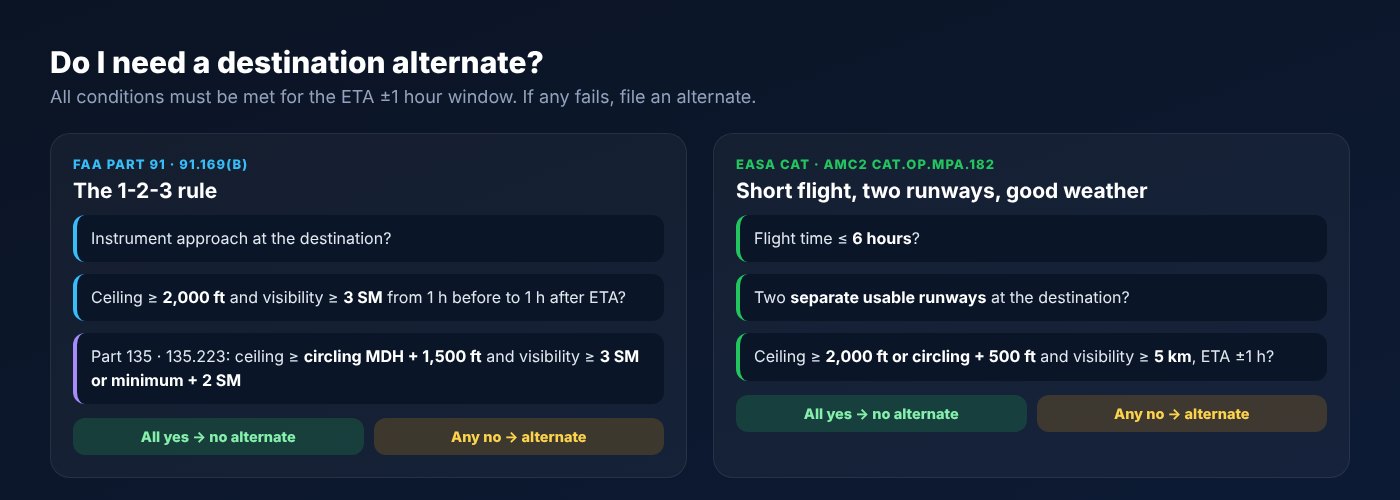
Under 14 CFR 91.169, an IFR flight plan must include an alternate unless the destination has a standard instrument approach and, for at least 1 hour before to 1 hour after the estimated time of arrival (ETA), the forecast shows a ceiling of at least 2,000 ft above airport elevation and visibility of at least 3 statute miles (SM). Pilots remember it as 1-2-3.
FAA Part 135: stricter and tied to the approach
For on-demand charter, 14 CFR 135.223 is more demanding. No alternate is needed only if, for at least 1 hour before and after ETA, the ceiling is at least 1,500 ft above the lowest circling minimum descent altitude (MDA). If circling is not authorised, the ceiling must be at least 1,500 ft above the lowest published minimum or 2,000 ft above the airport, whichever is higher. Visibility must be at least 3 SM, or 2 SM more than the lowest applicable visibility minimum, whichever is greater.
The difference is real at mountain airports. At Eagle County (KEGE), a circling minimum around 2,000 ft above the field (illustrative) means a 3,000 ft ceiling, comfortably legal under Part 91, still requires an alternate under Part 135.
EASA commercial air transport
Under the EASA fuel and aerodrome selection rules introduced in October 2022, a destination alternate is not required when the destination is an isolated aerodrome (with additional fuel instead), or when all of these apply: the planned flight time is 6 hours or less, two separate runways are usable at the destination, and the ETA ±1 hour forecast shows a ceiling of at least 2,000 ft or circling height plus 500 ft, whichever is greater, and ground visibility of at least 5 km.
EASA also requires two destination alternates when the destination forecast is below planning minima, or when reliable weather information for the destination is not available. In winter fog season, this is common at single-runway airports such as Milan Linate (LIML).
Landing minima versus planning minima
This is the core of alternate airport requirements. Landing minima, the decision altitude/height (DA/H) or minimum descent altitude/height (MDA/H) and the runway visual range (RVR) or visibility on the chart, are what you need to land. Planning minima are higher: they are what the forecast must show when you plan an airport as an alternate. The margin protects against forecasts being wrong, which is exactly the situation in which you would need the alternate.
FAA standard alternate minimums
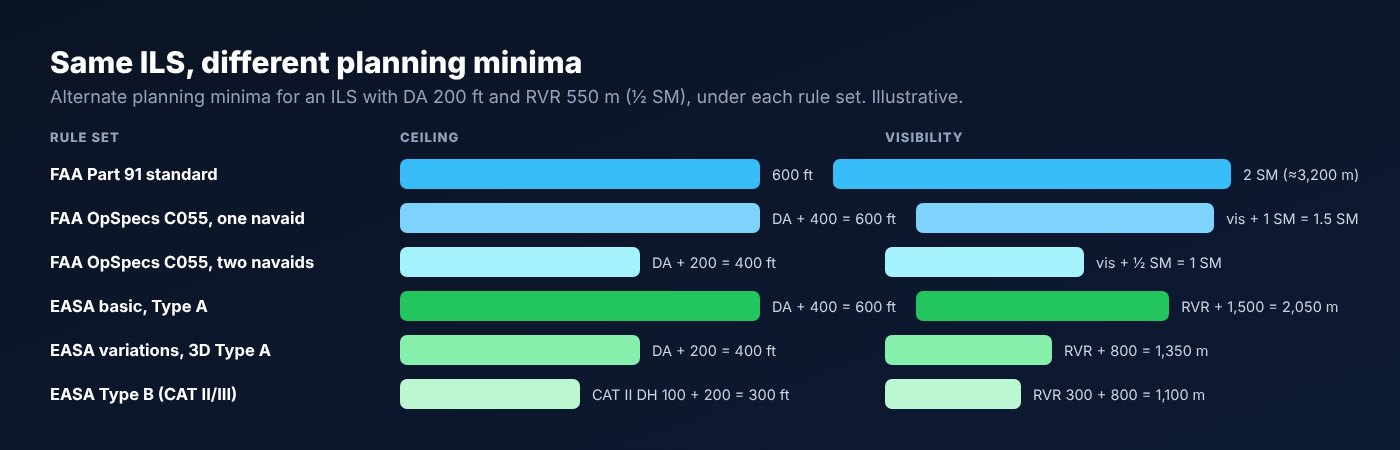
Unless the approach chart publishes different alternate minimums, 91.169(c) sets them at 600 ft ceiling and 2 SM visibility for a precision approach, and 800 ft and 2 SM for a non-precision approach. A chart may show non-standard alternate minimums (a triangle with an "A" symbol), or "NA", meaning the approach cannot be used for alternate planning, often because weather reporting or the facility is not available at certain times.
FAA operations specifications: derived minima
Part 121 and Part 135 operators typically plan with derived alternate minimums from operations specifications paragraph C055. With one usable navigation facility, add 400 ft to the DA or MDA and 1 SM to the visibility minimum. With at least two facilities providing approaches to different suitable runways, add 200 ft to the higher DA or MDA and ½ SM to the higher visibility minimum. For an ILS with a 200 ft DA and ½ SM visibility, one navaid gives 600 ft and 1½ SM.
EASA planning minima
EASA uses increments on top of the landing minima. In the basic fuel scheme (AMC6 CAT.OP.MPA.182), the destination alternate planning minima are:
| Approach at the alternate | Ceiling | RVR / visibility |
|---|---|---|
| Type B (CAT II/III) | DA/H + 200 ft | RVR/VIS + 800 m |
| Type A (CAT I, LPV, LNAV, VOR, NDB) | DA/H or MDA/H + 400 ft | RVR/VIS + 1,500 m |
| Circling | MDA/H + 400 ft | VIS + 1,500 m |
Operators approved for the basic scheme with variations (AMC8, with flights of 6 hours or less, two pilots and an operational control system) can use lower increments: for example DA/H + 200 ft and RVR + 800 m for a 3D Type A approach with a system minimum of 200 ft or less, or + 200 ft and + 1,000 m with two Type A approaches on separate navaids. Jeppesen's EASA aerodrome operating minimums summary reproduces both tables.
Non-commercial operators in Europe use different, simpler values. Part-NCO for non-complex aircraft, for example, uses fixed figures such as DA/H + 200 ft with at least 1,500 m for approaches below 250 ft, so check which Part applies before copying numbers between operations.
Check alternate airport requirements with the calculator
Choose a rule set and a scenario, or enter your own figures. Step 1 checks whether a destination alternate is required. Step 2 compares the alternate's forecast, including any TEMPO or PROB group, against the planning minima for the approach you will use. The bars show the published landing minimum, the planning minimum and the forecast, and the badges turn green or red.
The ETA ±1 hour window and TEMPO groups
Both EASA and most FAA operator rules assess the alternate's forecast from 1 hour before to 1 hour after the estimated arrival time there. Any forecast change group that overlaps that window counts.
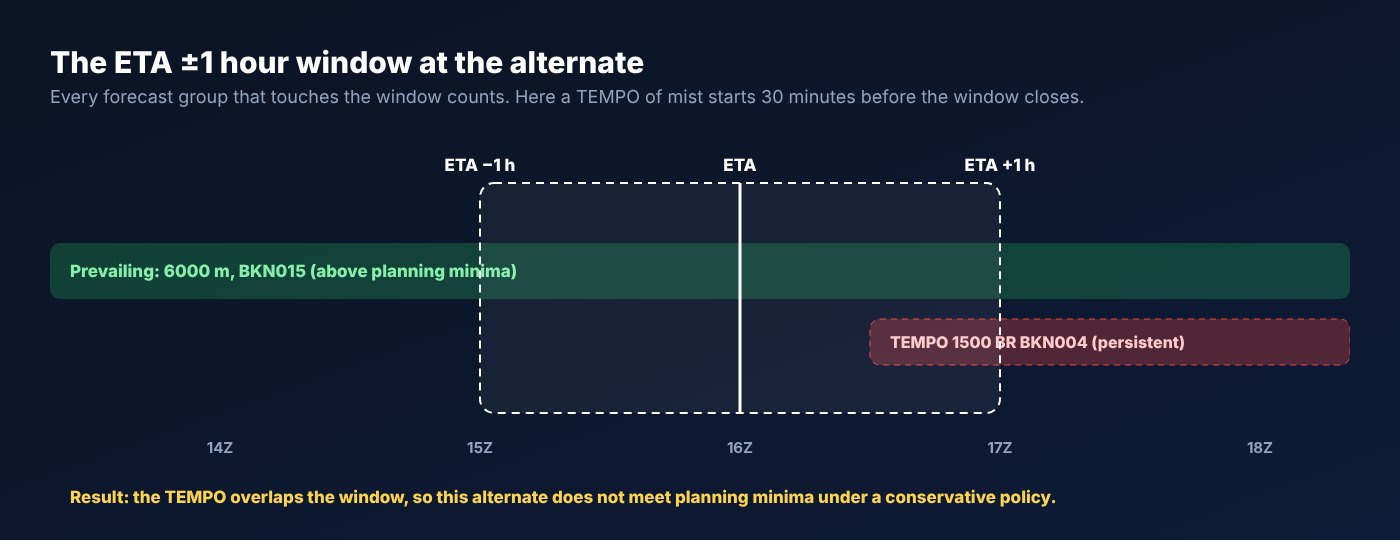
- FM and BECMG deteriorations apply from the start of the change, or from the start of the BECMG period to be conservative.
- TEMPO deteriorations with persistent conditions such as fog, mist, low cloud or continuous precipitation are normally applied. Many approved operations manuals allow transient TEMPO conditions, such as showers or thunderstorms, to be disregarded for planning, but only where the manual says so.
- PROB30 and PROB40 are treated according to the operator's approved policy. Many operators apply them at alternates even when they could legally ignore them.
For reading the groups correctly, see our guide on how to read a TAF.
An alternate is only as good as the worst forecast group inside its window.
GPS approaches at the alternate
Satellite-based approaches complicate alternate planning in the US. According to the FAA's Aeronautical Information Manual, chapter 1, aircraft with approved WAAS (Wide Area Augmentation System) equipment may plan an RNAV (GPS) approach at the alternate, but flight planning must use the LNAV or circling minimums line, not LPV or LNAV/VNAV. On arrival, if the avionics show LPV or LNAV/VNAV is available, the vertical guidance can be used to fly the approach. Aircraft without WAAS cannot plan to rely on GPS approaches at both the destination and the alternate. Always check GPS and WAAS NOTAMs for the arrival time.
Under EASA, an LPV approach is a 3D Type A approach, and the applicable planning increments follow from that classification and the operator's scheme.
Take-off alternates
If the weather at the departure airport is below the landing minima for the approach you would use to return, or returning is impossible for another reason, you need a take-off alternate. EASA and US Part 121 rules set the maximum distance: for twin-engine aeroplanes, within 1 hour of flight at one-engine-inoperative cruise speed in still air; for three- or four-engine aeroplanes, within 2 hours. The take-off alternate's forecast must meet the applicable landing minima for the ETA ±1 hour window. Part 91 has no take-off alternate requirement, but corporate flight departments commonly adopt one.
Example: fog at White Plains (KHPN) below the ILS minima at departure time, with a clear forecast at Bradley (KBDL), about 20 minutes' flight away. Bradley makes a natural take-off alternate.
A legal alternate is not always a usable one
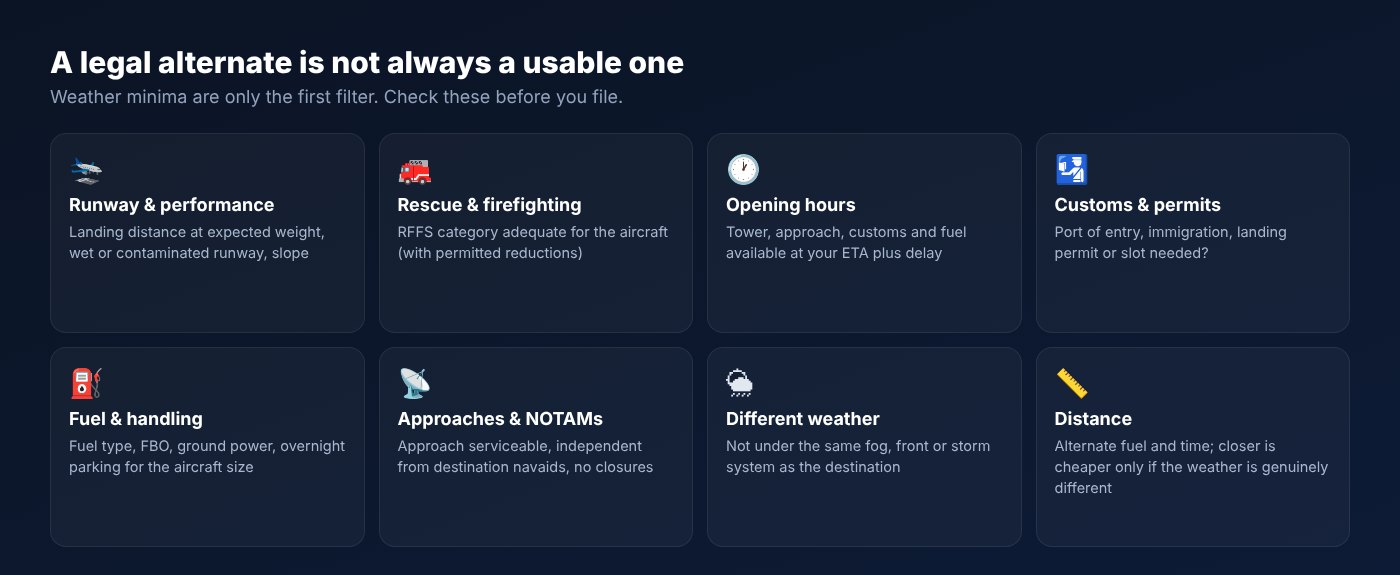
- Runway and performance: landing distance at your expected weight, on a wet or contaminated runway if forecast.
- Rescue and firefighting: the rescue and firefighting services (RFFS) category must be adequate for the aircraft, with any permitted reductions for alternates.
- Opening hours: tower, approach, customs and fuel must be available at your ETA, plus holding and delay.
- Customs and permits: on international flights, the alternate should be a port of entry, or you will be landing where you cannot legally clear in.
- Fuel and handling: fuel type, a fixed-base operator (FBO), ground power and parking for your aircraft size.
- Approaches and NOTAMs: check that the planned approach is serviceable and does not share a navaid or a failure mode with the destination. Our guide on how to read a NOTAM explains what to look for.
- Different weather: an alternate under the same fog bank or frontal system as the destination is not a real alternate.
- Distance: closer saves fuel, but only if the weather is genuinely independent.
Alternate airport requirements set the legal floor; real-world pairs show the practical trade-off. Venice (LIPZ) is a common alternate for Milan Linate, but in Po Valley fog both can be affected; Bologna or an airport north of the Alps may be the better choice. Salzburg (LOWS) has demanding approaches because of terrain, so its planning minima may be higher than a crew expects. Grand Junction (KGJT) is a frequent alternate for Eagle County because it sits lower and usually under different weather.
How to choose an alternate: a practical workflow
Meeting alternate airport requirements is a routine, not a single check. A workflow that works for most business aviation trips:
- Check whether one is required for the destination, using your operating rules and the ETA ±1 hour forecast.
- List candidates within reasonable fuel range, on the side away from the weather system.
- Pick the approach you will actually fly at each candidate, and check it is serviceable at your time.
- Compute planning minima for that approach under your rules and approvals.
- Compare with the forecast, including every TEMPO, PROB and BECMG group in the window.
- Check the non-weather factors above.
- Add a second alternate when the destination is marginal, the first alternate is close to minima, or the weather picture is uncertain.
- Update in flight. Re-check the alternate's latest METAR and TAF before top of descent; the plan made three hours ago may no longer hold.
Common mistakes: using landing minima instead of planning minima; ignoring a TEMPO at the edge of the window; planning LPV minima at a US alternate; picking an alternate under the same fog or front; forgetting customs or opening hours on international trips; assuming the chart's alternate minimums are standard when an "A" or "NA" note says otherwise; and copying Part-CAT increments into a Part-NCO or Part 91 operation, or the reverse.
Key takeaways
- FAA Part 91 uses the 1-2-3 rule; Part 135 ties the requirement to circling minima plus 1,500 ft and visibility plus 2 SM.
- EASA allows no destination alternate only for flights of 6 hours or less with two separate runways and good weather, or an isolated aerodrome.
- Planning minima at the alternate are higher than landing minima: 600-2 or 800-2 in Part 91, derived OpSpecs values in Part 135, and DA/H + 400 ft and + 1,500 m in the EASA basic scheme for Type A approaches.
- Apply every forecast group in the ETA ±1 hour window according to your approved policy.
- Check runway, RFFS, hours, customs, fuel, NOTAMs and independent weather, not just minima.
Check alternate weather in Aero Sync
The Aero Sync Aviation Weather tool shows decoded METARs and TAFs for any airport, so you can compare the destination and every candidate alternate's forecast window side by side before you file.
Frequently asked questions
What are the alternate airport requirements for IFR?
Under FAA Part 91, an alternate is required unless the destination has an instrument approach and the forecast from 1 hour before to 1 hour after ETA shows at least a 2,000 ft ceiling and 3 SM visibility. Part 135 and EASA rules are stricter and tied to approach minima, runways and flight time.
What is the 1-2-3 rule?
It is a memory aid for 14 CFR 91.169(b): for 1 hour before to 1 hour after ETA, if the ceiling is at least 2,000 ft and visibility at least 3 SM, no alternate is required.
What are standard alternate minimums?
Under 91.169(c), 600 ft and 2 SM for a precision approach and 800 ft and 2 SM for a non-precision approach, unless the chart publishes non-standard alternate minimums or "NA".
What are the Part 135 alternate requirements?
Under 135.223, an alternate is not required only if the ceiling is at least 1,500 ft above the lowest circling MDA (or the higher of lowest minimum + 1,500 ft and 2,000 ft) and visibility is at least 3 SM or 2 SM above the lowest minimum, from 1 hour before to 1 hour after ETA. Alternate minima come from the operator's OpSpecs.
What are derived alternate minimums?
Minimums calculated from the approach's landing minima under OpSpecs C055: one navaid adds 400 ft and 1 SM; two navaids to different suitable runways add 200 ft and ½ SM to the higher minima.
What are EASA alternate planning minima?
In the basic fuel scheme: Type B approaches DA/H + 200 ft and RVR/VIS + 800 m; Type A approaches DA/H or MDA/H + 400 ft and + 1,500 m; circling MDA/H + 400 ft and VIS + 1,500 m. Approved variations allow lower increments.
When does EASA not require a destination alternate?
When the destination is isolated, or when the flight is 6 hours or less, two separate runways are usable, and the ETA ±1 hour forecast shows a ceiling of at least 2,000 ft or circling + 500 ft and visibility of at least 5 km.
When are two destination alternates required?
Under EASA, when the destination forecast is below planning minima or when reliable meteorological information for the destination is not available. Many operators also add a second alternate when weather is marginal.
Can I use an LPV approach at my alternate?
In the US, WAAS-equipped aircraft may plan an RNAV (GPS) approach at the alternate but must plan with LNAV or circling minimums. LPV can be flown on arrival if available. Under EASA, LPV counts as a 3D Type A approach.
Do TEMPO groups count for alternate planning?
Persistent TEMPO deteriorations such as fog or low cloud normally count. Transient conditions such as showers may be disregarded only if your approved operations manual allows it.
How far can a take-off alternate be?
For twin-engine aeroplanes under EASA and US Part 121, within 1 hour at one-engine-inoperative cruise speed in still air; for three- or four-engine aeroplanes, within 2 hours.
What does "NA" mean in alternate minimums?
The approach cannot be used for alternate planning, often because weather reporting, the tower or a facility is not available. A triangle "A" symbol means non-standard alternate minimums apply.
What makes a good alternate airport?
Weather that meets planning minima and is independent of the destination, a serviceable approach, adequate runway and RFFS, open services at your ETA, customs where needed, fuel and handling, and reasonable distance.
Does Part 91 require a take-off alternate?
No, Part 91 has no take-off alternate requirement, but many corporate flight departments adopt one in their operations manual when departure weather is below landing minima.